Weight room walls fill up faster than any other space in a school athletic facility. Squat records, bench press milestones, power clean PRs, conditioning benchmarks, and team total achievements all compete for the same fixed surface. Add championship banners, motivational murals, and a mascot graphic, and the result is a wall that communicates everything and nothing at once.
A well-planned gym record board solves this by applying a clear decision framework: which strength and conditioning records belong on permanent display, which update seasonally, and when a digital system handles growth better than a fresh coat of vinyl letters.
Most weight rooms don’t need more wall space—they need a better organizational system. Athletic directors who approach their gym record board with defined categories, a priority tier, and an honest assessment of update frequency find that the wall communicates program achievement clearly without becoming an archive nobody reads.
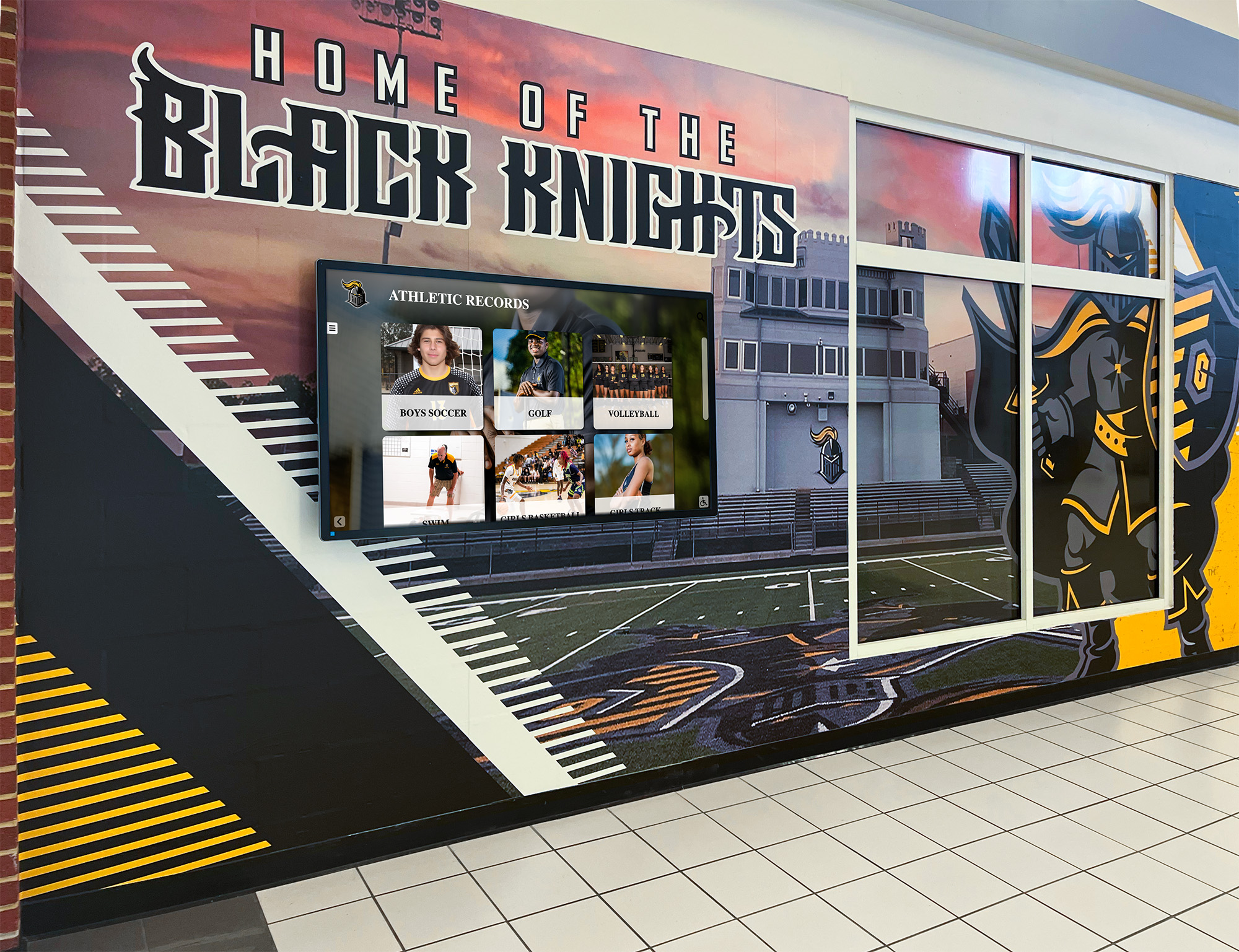
Pairing a mascot mural with a live digital records display keeps wall space curated while providing unlimited historical depth behind the screen
What Records Belong on a Gym Record Board
Before deciding on format or layout, define which records have earned permanent wall real estate. Not every number that has ever been lifted or run belongs on the wall—that thinking is precisely what creates clutter.
A gym record board serves three audiences simultaneously: current athletes who need visible goals, coaches who use records as benchmarks, and visitors—parents, alumni, and recruiters—who assess program quality in the first five seconds of walking in.
The records that serve all three audiences best tend to be:
- School all-time records by lift and weight class — These represent the program’s ceiling and rarely change. They belong on permanent display.
- Season-best records — Current-year bests show the program is active and competitive. They belong on a surface that can be updated without a vendor call.
- Conditioning benchmarks — Vertical jump, 40-yard dash, and shuttle run metrics show athletic development beyond raw strength. These are especially valuable for football and multi-sport programs.
- Team total records — Aggregate numbers such as combined team bench or total team clean create shared identity and give every athlete a stake in the display.
What doesn’t belong on the primary gym record board: participation logs, practice attendance recognitions, or any record that requires explanation to be meaningful. Keep the wall legible from ten feet away.
Strength Record Categories: A Planning Table
Use this table to audit which strength and conditioning records your program currently tracks, and to decide which display tier each record deserves.
| Record Category | Example | Display Tier | Update Frequency |
|---|---|---|---|
| All-time squat (by weight class) | 425 lbs — Class of 2019 | Permanent wall | Rarely |
| All-time bench press (by weight class) | 315 lbs — Class of 2022 | Permanent wall | Rarely |
| All-time power clean | 275 lbs — Class of 2021 | Permanent wall | Rarely |
| All-time deadlift | 495 lbs — Class of 2023 | Permanent wall | Rarely |
| Season-best squat (current year) | 390 lbs — Spring 2026 | Seasonal board or digital | Each season |
| Season conditioning leaders | Top 5 vertical jump | Seasonal board or digital | Weekly during season |
| 40-yard dash all-time | 4.41 sec — Class of 2020 | Permanent wall | Rarely |
| 5-10-5 shuttle run all-time | 3.97 sec — Class of 2024 | Permanent wall | Rarely |
| Team total squat record | 12,450 lbs combined | Permanent wall | Annually |
| Current season team total | 11,200 lbs and climbing | Digital display | Weekly |
The distinction between “permanent wall” and “seasonal/digital” is the key planning decision. Records that break fewer than once every two or three years belong on permanent static displays. Records that change every season belong on surfaces you can update without cost or lead time.
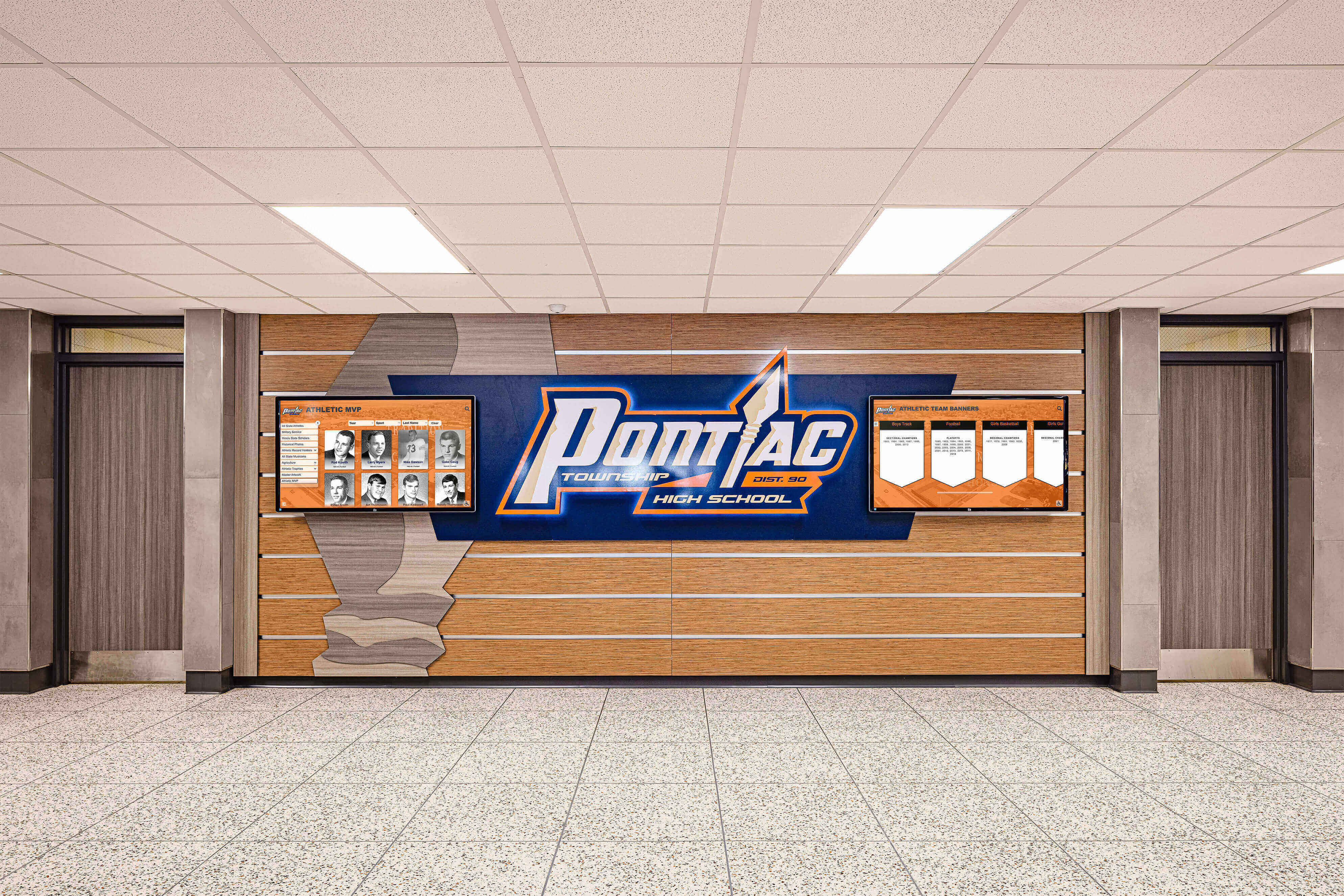
Purpose-built honor boards in the athletic corridor separate record categories clearly — visitors read the wall in seconds rather than searching through an undifferentiated list
The 3-Zone Wall Framework
Most weight rooms and gym lobbies can be organized into three display zones. Applying this framework before ordering any materials prevents the accumulation pattern that produces cluttered walls over time.
Zone 1 — All-Time Records (Permanent)
Zone 1 holds only your school’s all-time bests. These don’t change often, so a high-quality static surface—engraved acrylic, brushed aluminum plates, or a painted and sealed board—works well here. This zone earns the prime visual real estate: the wall opposite the entrance, or directly above the main lifting platform.
Limit Zone 1 to records that have stood for at least two full seasons or that represent genuine program milestones. Freshmen maxes from last November don’t belong here yet.
Zone 2 — Seasonal Records and Current Leaders
Zone 2 displays what the current class is achieving right now. This zone needs to be updatable weekly or monthly without professional help. Options range from a dry-erase board framed in school colors to a small digital display on a bracket mount.
If your program runs school digital signage across the building, Zone 2 is the natural place to connect a weight room screen to that network—centralizing updates and ensuring the records board stays current without a separate workflow.
Zone 3 — Conditioning Benchmarks and Team Goals
Zone 3 handles everything that doesn’t fit neatly into strength records but still communicates program athleticism: combine-style testing results, conditioning rankings, pre-season vs. post-season improvement metrics, and team goals for the upcoming season. A whiteboard or digital screen works well here because the content changes intentionally.
Planning Your Wall Layout Before You Order Anything
Wall space planning prevents the most common mistake: ordering a large static board only to discover it leaves no room for future additions or that the proportions conflict with existing features.
Use this layout planning table before committing to any fabrication or installation:
| Wall Feature | Dimensions | Location Priority | Display Type |
|---|---|---|---|
| All-time strength records | 4 ft × 3 ft minimum | Prime wall, eye-level center | Permanent static or framed digital |
| Season records and current leaders | 2 ft × 4 ft | Adjacent to Zone 1 | Writable surface or small digital |
| Conditioning benchmarks | 2 ft × 2 ft | Secondary wall or doorway | Whiteboard or rotating digital slide |
| Championship banners | Variable | Rafters or upper walls | Fabric banners (separate from records) |
| Motivational murals and mascot | Variable | Background treatment | Painted or vinyl wrap |
| Team total board | 1 ft × 3 ft | Near team meeting area | Chalkboard style or digital |
The key insight from this table: championship banners and motivational murals are not record boards, and they shouldn’t compete for the same wall space. Move banners to the rafters or a secondary wall. This frees up eye-level real estate for the records that athletes and recruits actually read.
For programs that want richer history visible during school events, photo galleries, and timeline displays, a digital screen in Zone 1 or Zone 2 can rotate through historical content—past champions, milestone athletes, team history photos—without consuming any additional wall space.
Digital vs. Static: When Each Approach Wins
The choice between a static gym record board and a digital display is not a budget question alone—it’s a question of update frequency and program ambition.
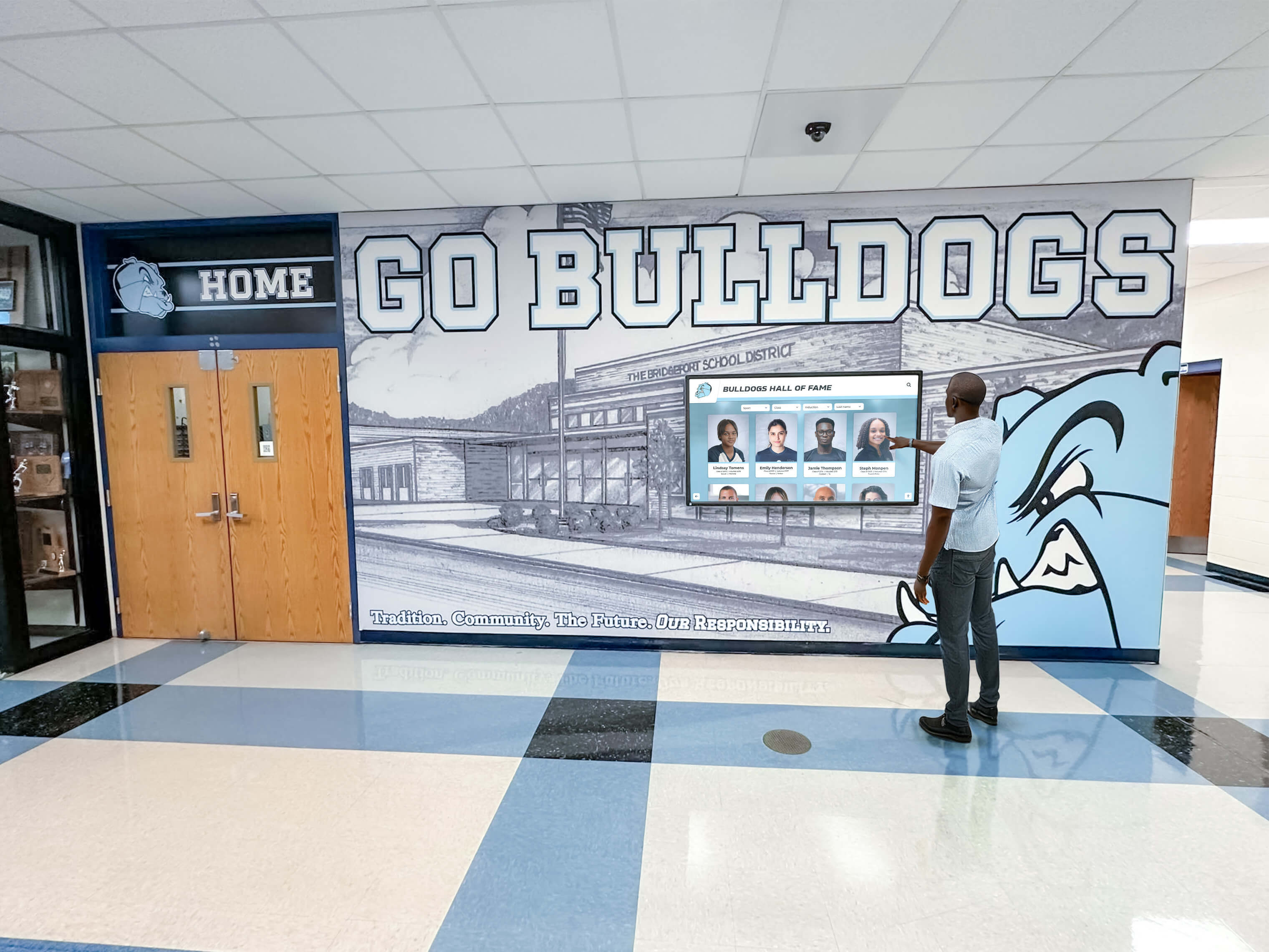
A touchscreen record display gives athletes, parents, and recruits interactive access to records that no static board can match in depth or engagement
Use this comparison to guide the decision for each zone in your weight room:
| Factor | Static Board | Digital Display |
|---|---|---|
| Best for | Records that change < once/year | Records that change weekly or monthly |
| Update cost | $50–$300 per change (vendor or labor) | $0 after installation (staff-managed) |
| Visual impact | High — permanent presence | High — motion and media draw attention |
| Depth of history | Limited to physical space | Unlimited — database behind the screen |
| Multi-sport support | One board per sport or a combined list | All sports on one screen with filters |
| Recruit impression | Traditional, established feel | Modern, tech-forward feel |
| ADA considerations | Fixed height and size constraints | Adjustable, touchscreen, QR-accessible |
| Ongoing maintenance | Periodic repainting or re-lettering | Software updates, no physical labor |
Static boards win when records rarely change and when the visual goal is a traditional, permanent aesthetic. A well-crafted permanent board for your school’s all-time squat and bench press records can anchor Zone 1 for decades.
Digital displays win when the program is growing, when multiple sports need to share wall space, or when coaches want to update records without calling a vendor. Programs managing records across football, basketball, soccer, track, and additional sports find that digital systems with unlimited screen capacity eliminate the forced choices that static boards impose.
For spring sport programs, season-ending records are worth cataloging even when they don’t break all-time bests. A digital system captures those milestones without requiring new physical materials. Programs tracking multi-season playoff and record histories—such as those following high school baseball playoff archives—benefit from searchable digital formats that no static board can replicate.
Extending Recognition Beyond the Weight Room
A gym record board that lives only in the weight room misses an engagement opportunity. Weight room records connect to game performance—and game performance connects to the broader recognition story that lives in lobbies, hallways, and trophy cases.
Athletic programs with strong recognition cultures typically extend their record displays beyond a single room:
- Lobby displays showing all-time leaders across all sports draw the broadest audience—students, parents, and community members who never enter the weight room
- Hallway athletic honor boards give records visibility throughout the school day, not just during team workouts
- Digital trophy cases pair physical awards with the record-holders who earned them, creating a connected recognition narrative
This is also where academic recognition intersects with athletic displays. Programs that recognize AP Scholar achievements alongside strength records demonstrate that the school celebrates the full range of student excellence—a message that resonates with college recruiters and community supporters alike.
The planning principles that define a strong athlete record board apply equally to other recognition categories. Teacher recognition programs use the same logic: clear criteria, consistent formatting, and a system that scales as the program grows without requiring constant redesign. Building those principles into your initial record board plan pays dividends across every recognition program the school runs.
For alumni communities returning for reunions and events, a searchable digital record board that surfaces their era of records creates immediate personal connection. Planning alumni engagement around recognition displays is a natural extension of a well-organized record board strategy, particularly for programs with deep athletic histories.
Maintenance and Longevity
A gym record board is only as good as its last update. Boards showing records from five years ago with no recent changes communicate stagnation, not history.
Static boards: Budget for professional re-lettering or re-engraving every two to three years even when records don’t change—materials fade and show wear. Build the maintenance line into your annual facilities budget so updates don’t require a separate capital request.
Digital displays: Establish a record update protocol at the start of each season. Assign one staff member ownership of the display content management system. A digital record board that no one updates is worse than a stale static board—it signals that the technology was an investment that lost institutional attention.
For programs that also manage outdoor athletic facilities, the maintenance discipline applied to a well-kept baseball field through seasonal cycles applies equally to recognition systems: seasonal attention, defined ownership, and documented procedures prevent the slow decay that makes facilities look neglected.
Multi-sport programs covering everything from football to soccer training and conditioning generate the widest range of record categories. A digital system that consolidates those records on a unified platform reduces the maintenance burden compared to managing separate static boards for each sport.
Academic programs follow the same logic: whether tracking academic distinction levels like cum laude or athletic strength records, programs that define their criteria clearly upfront maintain more credible and consistent displays over time.
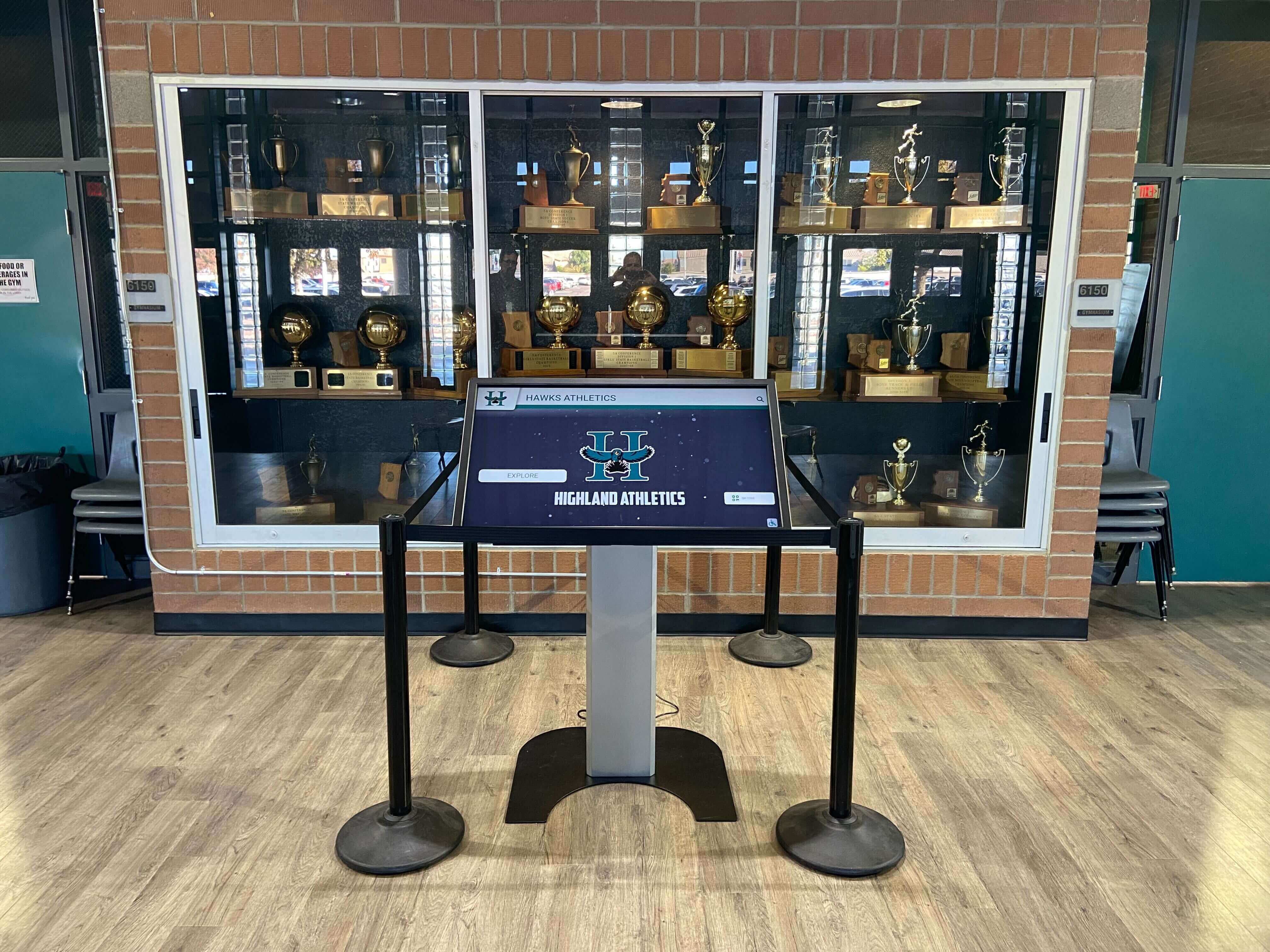
A touchscreen kiosk in the trophy case extends the record board into the school's main public-facing space — parents, recruits, and community visitors engage without ever entering the weight room
Getting Started: A Practical Checklist
Before ordering materials or scheduling installation, complete these steps:
Audit
- Walk the weight room and list every current display element
- Identify which records have been unchanged for three or more years
- Identify which records change seasonally or weekly
- Note available wall dimensions for each zone
Plan
- Assign each record category to Zone 1, 2, or 3 using the tables above
- Determine update frequency for each zone
- Decide static vs. digital for each zone based on the comparison table
- Measure wall space and confirm it fits your planned layout before ordering
Implement
- Order permanent materials only for Zone 1 all-time records
- Choose an updatable surface for Zone 2 seasonal records
- Establish a named staff owner for each zone’s update schedule
- Schedule an annual review cycle to confirm all records are current and accurate
Ready to see how a digital gym record board handles every strength milestone without crowding your wall?
Rocket Alumni Solutions designs and installs touchscreen recognition systems for school athletic departments — digital record boards, interactive hall of fame walls, and archival displays that scale with your program. Schedule a free demo and get a recommendation tailored to your weight room layout and record categories.































