
The Masters Golf Tournament stands as one of the most prestigious events in all of sports—a tradition unlike any other that combines athletic excellence, storied history, and unwavering commitment to tradition. For golf clubs, sports organizations, and educational institutions with strong golf programs, preserving and celebrating this rich heritage presents unique opportunities to engage members, honor achievements, and inspire future generations. Interactive touchscreen displays offer innovative solutions for bringing The Masters’ remarkable history to life in ways that static plaques and traditional trophy cases simply cannot match.
The Masters: A Tradition Unlike Any Other
Since its inception in 1934, The Masters has captivated golf enthusiasts worldwide with its unique blend of championship golf and cherished traditions. Understanding the tournament’s significance helps contextualize why comprehensive historical recognition matters for organizations celebrating golf excellence.
The Tournament’s Distinguished Heritage
The Masters Tournament represents the culmination of Bobby Jones and Clifford Roberts’ vision to create a golf event that would showcase the world’s finest players while maintaining intimate connections to tradition and sportsmanship. Augusta National Golf Club, the tournament’s permanent home, provides a pristine stage where golf history unfolds each April.
The tournament’s distinctive characteristics set it apart from other major championships. The coveted Green Jacket awarded to champions symbolizes membership in one of golf’s most exclusive fraternities. The traditional Champions Dinner brings past winners together annually, creating bonds that transcend competitive rivalries. Augusta’s azaleas, dogwoods, and meticulously maintained grounds provide breathtaking natural beauty that frames championship drama.

Iconic Moments That Define The Masters
The Masters has produced countless memorable moments that have become woven into golf’s cultural fabric. Jack Nicklaus’s record six Green Jackets established a standard of sustained excellence that may never be matched. Tiger Woods’s 1997 victory at age 21, winning by 12 strokes, announced a new era in golf and changed the sport forever. His 2019 comeback victory, 14 years after his previous major championship, provided one of sport’s most compelling redemption stories.
Gene Sarazen’s “shot heard ‘round the world”—a double eagle on the par-5 15th hole in 1935—remains one of golf’s most celebrated shots. Arnold Palmer’s four Green Jackets in seven years during the late 1950s and early 1960s helped establish The Masters as a television spectacle. Phil Mickelson’s 2004 victory ended his major championship drought, while his 2021 PGA Championship win at age 50 demonstrated that excellence knows no age limits.
These moments, along with countless other dramatic finishes, remarkable shots, and inspiring comebacks, comprise The Masters’ rich tapestry—a history that deserves comprehensive preservation and engaging presentation.
Why Golf Organizations Need Comprehensive Historical Recognition
Whether you manage a country club, oversee a collegiate golf program, or lead a golf association, thoughtfully preserving and presenting your organization’s history creates significant benefits that extend far beyond simple nostalgia.
Building Organizational Identity and Pride
Historical recognition establishes organizational identity by demonstrating values, traditions, and standards of excellence that define your institution. When members understand their club’s championship history, founding traditions, and distinguished alumni who preceded them, they develop deeper connections to the organization and stronger investment in upholding its reputation.
For golf record boards and championship recognition, comprehensive historical displays inspire current players by showcasing what previous generations accomplished. Young golfers seeing records set decades ago gain motivation to pursue their own excellence while understanding they’re part of continuing traditions.

Engaging Members Across Generations
Multi-generational organizations benefit enormously from historical recognition that connects longtime members with newer participants. Senior members appreciate seeing their achievements and contributions honored appropriately, while younger members gain perspective understanding the club’s evolution and the individuals who shaped its character.
Interactive displays enable members to explore history at their own pace, focusing on eras or achievements that resonate personally. A member who joined in the 1980s can locate their tournament victories, while a new member discovers founding traditions. This personalized exploration creates engagement that passive displays cannot match.
Supporting Fundraising and Development Initiatives
Well-presented organizational history supports development efforts by demonstrating institutional stability, honoring donor contributions, and creating emotional connections that inspire giving. When prospective donors see comprehensive recognition of previous generations’ contributions and achievements, they understand the lasting impact their own support could create.
For educational institutions with golf programs, recognizing college signings and recruiting achievements demonstrates program success that attracts prospective student-athletes and their families while maintaining alumni engagement.

Interactive Touchscreen Technology: Transforming Golf History Presentation
Traditional golf recognition—trophy cases displaying championship hardware, plaques engraved with tournament winners, framed photographs of champions—serves important purposes but faces inherent limitations. Interactive touchscreen displays address these constraints while creating engagement opportunities impossible with static installations.
The Limitations of Traditional Golf Recognition
Physical trophy cases and wall-mounted displays accommodate finite collections. Clubs must make difficult decisions about which tournaments to showcase, which champions to feature, and how to allocate limited display space. As organizations accumulate history, older achievements often migrate to storage, unseen by current members.
Static displays provide minimal information beyond basic facts—tournament names, winners, years. Members seeking deeper context about championship circumstances, competitor fields, or winner backgrounds must research independently. This limited storytelling reduces engagement and fails to capture compelling narratives behind bare statistics.
Updating traditional displays requires expensive physical reinstallation. Adding new tournament winners means commissioning new plaques, rearranging existing displays, or expanding into additional wall space. Correcting errors or adding newly discovered historical information proves similarly challenging.
How Interactive Displays Transform Golf Recognition
Digital recognition platforms solve these challenges while creating unprecedented opportunities for comprehensive, engaging historical presentation. Unlimited digital capacity means every tournament, championship, and significant achievement receives appropriate recognition without space constraints.
Rich multimedia integration brings golf history to life through tournament footage, winner interviews, historical photographs, and detailed statistical analysis. Rather than reading a name and year on a plaque, members can watch championship-winning putts, hear champions reflect on their victories, and explore complete tournament leaderboards showing how competitions unfolded.
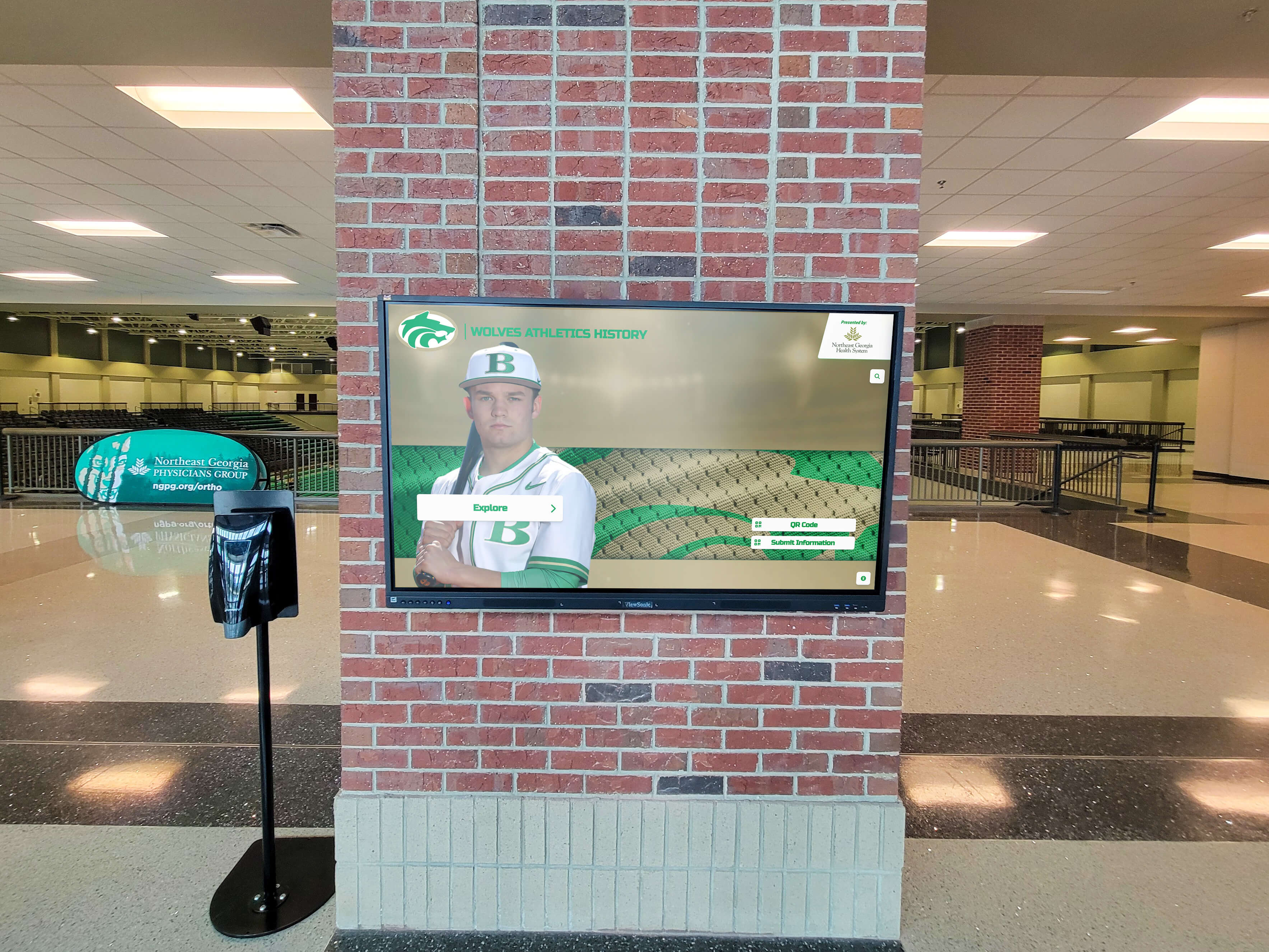
Intuitive search and filtering enable members to quickly find specific information. A member seeking their club championship victories from the 1990s can locate them instantly, while another exploring the club’s founding era can filter content to that period. This personalized exploration accommodates diverse interests and knowledge levels.
Cloud-based content management allows instant updates from any location. When tournaments conclude, staff can add results immediately rather than waiting months for plaque production. Correcting errors or enhancing entries with newly discovered materials takes minutes rather than requiring expensive physical reinstallation.
Essential Features for Golf History Displays
Effective golf historical displays combine specific capabilities that create engaging, informative experiences for diverse audiences:
Comprehensive Tournament Archives
Document complete tournament histories including championship winners across all club events, runner-up finishes and playoff results, course records and scoring milestones, weather conditions and course setup details, and notable performances even from non-winners. This comprehensive documentation ensures every significant competitive moment receives recognition.
Detailed Player Profiles
Create rich biographical content for champions and distinguished members including complete competitive records at your facility, career highlights and achievements beyond your club, biographical information and career details, personal reflections or interview content, and multimedia elements bringing individuals to life. These profiles transform names on leaderboards into fully realized individuals whose stories inspire current members.
Historical Timeline Navigation
Organize content chronologically allowing users to explore how your organization evolved across decades. Timeline views might show facility development and course modifications, membership milestones and organizational growth, rule changes and format evolutions, and broader golf history context showing how your club’s story connects to sport-wide developments.
Statistical Analysis and Comparison
Provide tools enabling members to explore statistical dimensions of your organization’s competitive history. Features might include filterable leaderboards showing multiple tournaments and eras, scoring average trends across different time periods, head-to-head records between notable competitors, and contextual comparisons placing individual achievements within appropriate historical frameworks.

Creating Compelling Golf History Content
Technology platforms provide capabilities, but thoughtful content development determines whether historical displays achieve their potential to inform, inspire, and engage audiences.
Research and Documentation: Building Your Historical Foundation
Comprehensive historical recognition begins with systematic research gathering information from authoritative sources. This foundation ensures accuracy while identifying gaps where additional investigation might uncover forgotten achievements or overlooked contributors.
Primary Source Materials
Start with materials your organization already possesses. Tournament programs and results sheets provide official records of competitive outcomes. Member publications and newsletters document events from contemporary perspectives. Meeting minutes and correspondence reveal decision-making processes and organizational evolution. Photograph collections show facilities, members, and events across different eras.
For organizations with deep histories, local newspaper archives often contain tournament coverage, member profiles, and facility development stories that supplement internal documentation. Regional golf associations may maintain records of qualifying competitions, amateur championships, or inter-club events involving your members.
Oral History Collection
Long-tenured members, former staff, and club historians often possess institutional knowledge not captured in written records. Conducting video or audio interviews preserves these memories while creating engaging content for historical displays. Interviews might explore founding member experiences, championship moments and competitive rivalries, facility evolution and course design changes, and cultural shifts in membership and programming.
These personal narratives add human dimensions to factual records, transforming dates and scores into compelling stories that resonate emotionally with current members.
Organizing Content for Intuitive Navigation
How you structure historical content significantly impacts user experience and engagement. Effective organization accommodates multiple exploration approaches, allowing different users to find information through their preferred pathways.
Chronological Organization
Decade-by-decade structure provides natural progression showing organizational evolution over time. Users can explore specific eras, discovering what golf and your organization were like during periods matching their personal history or curiosity.
Tournament-Based Structure
Organizing content around specific competitions allows focused exploration of particular events. Your club championship history might include complete winner listings across all years, memorable finish descriptions and playoff results, scoring records and course condition details, and format evolution showing how competitions changed.
Individual-Focused Navigation
Member-centric organization enables quick location of specific individuals’ achievements. Searching a member name might reveal their complete competitive record at your facility, leadership roles and committee service, and contributions to organizational development.
Thematic Collections
Curated groupings highlight specific aspects of your history through thematic lenses. Collections might explore course evolution showing facility development, family legacy featuring multi-generational member families, championship dynasties examining dominant competitive eras, or founding traditions documenting your organization’s establishment and early years.

Implementation Strategy: Bringing Your Golf History to Life
Moving from concept to operational historical recognition requires systematic planning addressing content development, technology selection, installation logistics, and ongoing maintenance.
Phase 1: Planning and Goal Setting (Months 1-2)
Begin by establishing clear objectives for your historical recognition program. Are you primarily focused on member engagement, recruiting and marketing, fundraising support, or preserving institutional memory? Different priorities influence content emphasis, technology choices, and resource allocation.
Form a historical committee including longtime members who remember significant eras, staff with access to organizational records, technology-comfortable individuals who can evaluate platform options, and communications professionals who can ensure quality content development.
Conduct a historical audit assessing what materials currently exist, their condition and organization, what gaps exist in documentation, and what resources are available for content development.
Phase 2: Content Development (Months 3-6)
Systematic content development represents the most time-intensive implementation phase. Begin with recent history where documentation is comprehensive and memories fresh, then work backward through earlier eras where research may prove more challenging.
For tournament history, create standardized entry formats ensuring consistent information across all events. Each tournament entry might include event name and date, complete leaderboard showing top finishers, winner profile with biographical details and achievements, course conditions and scoring analysis, and multimedia elements like photographs or video footage.
Develop comprehensive player profiles for champions and distinguished members. Research career achievements, competitive records, leadership contributions, and post-competitive involvement. Interview living subjects when possible, capturing personal reflections and institutional knowledge.
Digitize historical photographs, programs, and documents at high resolution ensuring future usability as display technologies improve. Organize digital assets with consistent naming conventions, appropriate metadata, and logical folder structures enabling efficient content management.

Phase 3: Technology Selection and Installation (Months 6-8)
Choose platforms designed specifically for recognition and historical presentation rather than generic digital signage systems. Purpose-built solutions include features like sophisticated search and filtering, multimedia integration, responsive mobile access, and intuitive content management systems requiring no technical expertise.
Solutions like Rocket Alumni Solutions provide comprehensive platforms specifically designed for recognition programs, combining powerful display capabilities with user-friendly management interfaces that make ongoing content updates simple for non-technical staff.
Hardware selection depends on installation location, viewing distances, and aesthetic preferences. Wall-mounted displays integrate cleanly with existing spaces, freestanding kiosks create destination recognition areas, and custom architectural integration provides premium installations for high-visibility locations.
Professional installation ensures proper mounting, network connectivity, power management, and optimal viewing angles that maximize engagement and longevity.
Phase 4: Launch and Ongoing Enhancement (Month 9+)
Create visibility for your historical recognition program through formal unveiling during high-attendance events, member communications highlighting features and content, guided tours demonstrating navigation and discovery, and social media promotion extending reach beyond physical facility.
Establish regular update cycles maintaining content currency and member engagement. Add recent tournament results promptly, enhance existing entries with newly discovered materials, feature rotating historical spotlights highlighting specific eras or individuals, and incorporate member-contributed content and reminiscences.
Connecting Golf History to Broader Recognition Programs
Golf historical recognition often functions best as part of comprehensive organizational recognition rather than isolated initiatives. Athletic walls of honor integrate golf achievements with other sports for educational institutions with diverse programs. Interactive timelines documenting organizational history place competitive achievements within broader institutional evolution.

For clubs and organizations, comprehensive recognition might include tournament championship history, member achievement galleries, facility development documentation, and leadership and volunteer recognition. This holistic approach demonstrates that organizational excellence extends beyond competitive results to encompass volunteer leadership, facility stewardship, and community building.
Integration with advancement programs supports fundraising by honoring donor contributions, demonstrating institutional stability and tradition, creating emotional connections inspiring giving, and providing visibility for recognition societies and capital campaign supporters.
Best Practices for Sustainable Golf History Programs
Creating recognition that remains valuable, accurate, and engaging across decades requires strategic planning and ongoing commitment.
Establish Clear Governance and Responsibility
Assign specific individuals clear accountability for content accuracy, regular updates, quality control, and technical maintenance. Document processes ensuring smooth transitions when key personnel change roles or retire.
Implement verification procedures confirming historical accuracy, appropriate contextualization, consistent quality standards, and timely error correction. Accuracy matters profoundly in historical recognition—members trust institutional records to accurately document their achievements and organizational history.
Maintain Content Quality Standards
Establish minimum quality thresholds for all content elements. Photograph digitization should meet resolution standards ensuring future usability. Writing should maintain consistent style, appropriate tone, and grammatical correctness. Biographical information must be verified through reliable sources rather than assumptions or incomplete recollections.
Create standardized templates for common content types ensuring consistency across entries. Tournament results might follow identical formats regardless of year or event. Player profiles might use consistent structural elements making information location predictable and navigation intuitive.
Build Regular Update Cycles
Effective recognition programs maintain momentum through systematic ongoing activity rather than sporadic attention. Schedule quarterly content development sessions adding recent achievements, enhancing existing entries, featuring historical spotlights, and incorporating user contributions.
Coordinate updates with organizational calendars, highlighting relevant historical content during tournaments, anniversaries, or significant events. A club championship week might feature historical spotlights on previous champions, creating connections between current competition and organizational tradition.

Measuring Success and Demonstrating Value
Evaluating historical recognition program effectiveness helps justify continued investment while identifying enhancement opportunities.
Quantitative Engagement Metrics
Track measurable indicators revealing program reach and impact. For physical touchscreen displays, monitor interaction frequency, average engagement duration, peak usage times, and most-accessed content categories. For web-based platforms, analyze unique visitors, page views, session duration, search patterns, and social sharing activity.
Growing engagement suggests content resonates with audiences and awareness increases. Declining metrics might indicate need for content refreshment, improved promotion, or technical troubleshooting.
Qualitative Impact Assessment
Beyond numbers, gather feedback revealing how recognition influences organizational culture. Conduct member surveys assessing awareness of historical content, frequency of display interaction, influence on organizational pride and connection, and suggestions for enhancement.
Collect anecdotal feedback about specific impact instances—alumni reconnecting through shared memories, recruiting conversations strengthened by historical context, or fundraising discussions influenced by comprehensive recognition of previous generations’ contributions.
Return on Investment Analysis
While cultural benefits resist precise quantification, organizations can assess recognition program value through multiple lenses. Compare engagement metrics to traditional recognition approaches, evaluate correlation with member retention and satisfaction, assess influence on recruiting and reputation, and analyze connection to fundraising and development success.
Many organizations implementing digital recognition displays report that enhanced member engagement, improved recruiting outcomes, and strengthened fundraising results provide returns justifying initial investment and ongoing maintenance costs.
Conclusion: Honoring Golf’s Rich Heritage Through Modern Recognition
Golf’s deep respect for history and tradition makes comprehensive historical recognition particularly appropriate for clubs, educational programs, and organizations celebrating the sport’s excellence. The Masters Tournament exemplifies how honoring tradition while embracing excellence creates experiences that inspire participants and captivate audiences across generations.
Interactive touchscreen technology enables golf organizations to preserve and present their unique histories in ways that engage members, inspire current competitors, and demonstrate organizational values. Rather than limiting recognition to trophy cases displaying finite collections, digital platforms provide unlimited capacity for comprehensive documentation that ensures every achievement, champion, and significant moment receives appropriate recognition.
Whether your organization’s golf history spans decades or centuries, the stories you preserve today shape how future generations understand, value, and build upon foundations previous members established. By implementing thoughtful historical recognition that leverages modern technology while respecting timeless traditions, you create lasting tributes to excellence that strengthen organizational identity and inspire continued achievement.
Ready to transform how your organization preserves and presents golf history? Explore how Rocket Alumni Solutions’ purpose-built platforms make comprehensive historical recognition accessible and sustainable for organizations of all sizes, creating engaging experiences that honor tradition while embracing innovation.






















