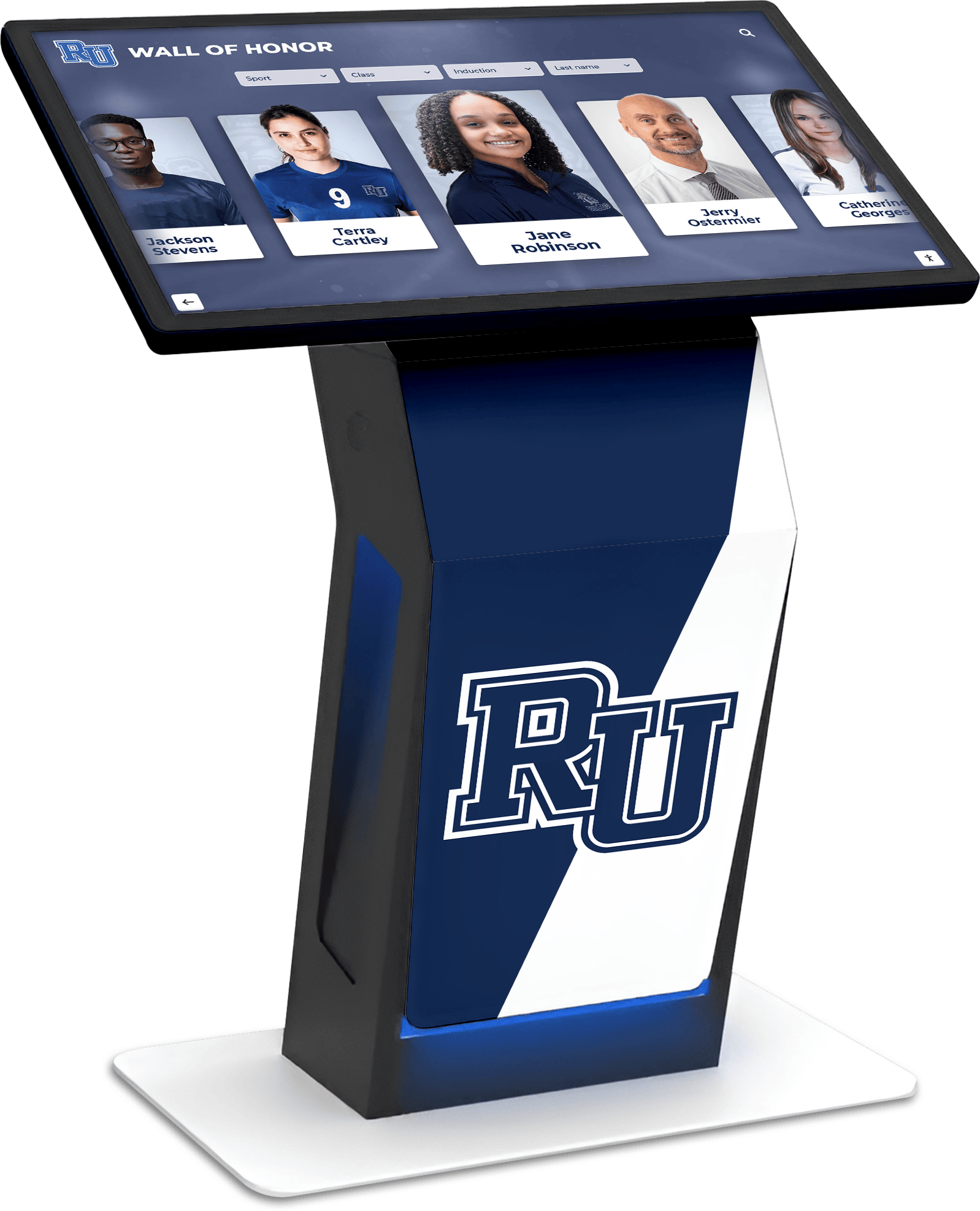
A publicly accessible touchscreen in your school’s lobby or athletic hallway is a network-connected device. It runs an operating system, communicates with a content management platform, and—in many installations—touches your school’s Wi-Fi, VLAN, or data integration layer. When a CVE is published for the OS your display runs, or when a security researcher discloses a vulnerability in a common CMS plugin your recognition platform uses, your district’s exposure doesn’t wait for your next scheduled patch window. Without a formal policy for identifying, classifying, and remediating those vulnerabilities, the gap between disclosure and remediation is measured by luck rather than process.
A touchscreen recognition display vulnerability management policy defines how vulnerabilities are identified, how severity is assessed, who holds each role in the remediation cycle, what testing must happen before and after a fix is deployed, how the remediation is documented, and when the institution must escalate beyond its own capacity. This policy template is written for school IT coordinators, athletic directors, facilities directors, and advancement staff responsible for recognition displays in K–12 and higher education settings.
Nothing in this article constitutes legal advice. Schools with specific regulatory obligations—including FERPA, state data privacy laws, or district cybersecurity mandates—should have qualified counsel and IT leadership review any policy before formal adoption.
The short answer: a vulnerability management policy requires regular scanning and vendor monitoring to surface vulnerabilities, assigns a severity rating to each finding, maps that severity to a maximum remediation timeline, requires a staging test before any fix reaches the live display, and mandates a written vulnerability record for every finding through closure. The complete template below provides the roles table, severity classification guide, numbered remediation cycle, pre-remediation checklist, testing checklist, remediation record format, and escalation thresholds.
How Vulnerability Management Differs from Patch Management
These two policies govern related but distinct activities. Patch management governs the proactive, scheduled application of vendor-released updates on a recurring cycle. Vulnerability management governs the reactive, risk-driven process of identifying specific security weaknesses—whether patched or not—and remediating them within defined timelines based on their severity.
In practice, the two overlap: a critical patch often addresses a known vulnerability. When it does, the vulnerability management policy sets the remediation deadline and the patch management policy governs how the patch is tested and applied. Schools that have already documented a patch management process should treat this vulnerability management policy as the risk-classification layer that determines when a patch cannot wait for the next scheduled window.
Schools maintaining interactive digital signage and recognition displays as public-facing infrastructure have particular reason to maintain both policies, since vulnerabilities on publicly accessible, lobby-mounted devices carry different reputational and operational consequences than vulnerabilities on internal administrative workstations.
Policy Scope
This policy applies to:
- All interactive touchscreen recognition displays operated, leased, or contracted by the school, regardless of whether they are managed by in-house IT staff or a third-party vendor
- All hardware components that connect to or support the display, including media players, kiosk controllers, and network switches in the display’s network segment
- All software layers: operating system, content management system, display application, CMS plugins, and API connectors (such as score feeds or alumni data integrations)
- All staff, contractors, and vendors with administrative or network access to the display infrastructure
This policy does not govern:
- Content accuracy or content change approvals — those are governed by the recognition display change management and audit trail policies
- Routine scheduled software updates not associated with a disclosed vulnerability — those are governed by the patch management policy
- Physical security of the display hardware — that is governed by the facilities security policy
Vulnerability Sources
Vulnerabilities on recognition display systems typically enter awareness through five channels. Teams that monitor all five identify exposures faster than teams that rely on vendor notifications alone.
| Source | What to Monitor | Who Monitors It |
|---|---|---|
| Vendor security advisories | Vendor-issued security bulletins and CVE disclosures for the display platform, CMS, and operating system | IT Coordinator or designated vendor contact |
| National Vulnerability Database (NVD) | NIST NVD entries for software components running on the display (by product name and version) | IT Coordinator |
| Automated vulnerability scanner | Network-accessible services, open ports, and known CVEs identified by scheduled scans | IT Coordinator |
| CMS platform notifications | In-platform security notices, plugin changelogs flagging security fixes, and CMS security mailing lists | CMS Administrator |
| District or state cybersecurity alerts | Threat intelligence bulletins from the district CISO, state DOE technology office, or CISA advisories applicable to display hardware or software | IT Coordinator |
At minimum, the IT Coordinator must review vendor security advisories and NVD entries for all active software components once per month. Teams with access to automated scanning tools should schedule scans on a monthly basis at minimum, with additional scans triggered after any software update, network reconfiguration, or vendor-reported disclosure.
Roles and Responsibilities
Every step in the vulnerability management cycle must have a named individual. In small departments where one person holds multiple roles, no individual should both classify a vulnerability and be the sole verifier that the remediation succeeded—independent verification at the post-remediation stage is the minimum separation required.
| Role | Primary Responsibility | Vulnerability Cycle Steps |
|---|---|---|
| IT Coordinator | Owns the vulnerability register, monitors all five vulnerability sources, holds final authority over remediation scheduling | Receives and logs vulnerability reports; classifies severity; schedules remediation windows; confirms backup readiness; authorizes production remediation; verifies escalation thresholds |
| CMS Administrator | Executes remediation steps in staging and production environments | Applies fixes to staging; runs the remediation test checklist; applies fixes to production; logs completion; files the vulnerability record |
| Content Approver | Confirms event blackout calendar before remediation window is scheduled; co-signs closed vulnerability records | Reviews proposed window against school calendar; approves or reschedules; co-signs closure of records for High and Critical findings |
| Facilities Coordinator | Manages physical access to display hardware for remediation requiring on-site work | Confirms hardware access for extended remediation windows; coordinates with custodial or security staff for after-hours access |
| Vendor / Platform Provider | Issues vulnerability notifications and patches; may perform vendor-managed remediations under contract | Issues advance security notifications; provides fix packages or hotfixes; confirms remediation version numbers; documents residual risk if a fix is not yet available |
| District CISO or IT Leadership | Receives escalation for Critical findings and any unresolved High findings beyond the remediation window | Receives escalation notifications; authorizes risk acceptance decisions when remediation is not possible within policy timelines; coordinates district-level response |
Severity Classification
Classifying a vulnerability before scheduling remediation determines the maximum time allowed before a fix must be in production, the testing depth required, and whether escalation is mandatory. Use the classification table below as the primary reference. When documentation is insufficient to assign a severity, classify at the higher level until additional information is available.
| Severity | CVSS Score Range | Description | Maximum Remediation Timeline | Escalation Required? |
|---|---|---|---|---|
| Critical | 9.0–10.0 | Remotely exploitable without authentication; potential for data exfiltration, lateral network movement, or complete display system compromise | 7 calendar days from identification | Yes — notify District CISO within 24 hours of identification |
| High | 7.0–8.9 | Significant attack surface with likely exploitation; could affect display availability, content integrity, or connected network segments | 30 calendar days from identification | Yes — notify District CISO if not resolved within 21 days |
| Medium | 4.0–6.9 | Moderate risk requiring specific conditions for exploitation; limited scope or impact | 90 calendar days; defer to next scheduled maintenance window if within 14 days | No, unless combined with other active findings that raise aggregate risk |
| Low | 0.1–3.9 | Low exploitability or minimal impact; no immediate risk to the display or network | 180 calendar days; address in the next extended maintenance window | No |
| Informational | N/A | Configuration weaknesses, best-practice gaps, or findings with no direct exploitability | Address during annual policy review or next major platform upgrade | No |
When a vendor has not yet issued a fix for a disclosed vulnerability, the IT Coordinator must document a risk acceptance decision signed by the District CISO or equivalent. The vulnerability remains open in the register until a fix is available and applied.
The Vulnerability Remediation Cycle
Run the same numbered cycle for every vulnerability regardless of severity. Severity determines the timeline; the cycle determines the process.
Step 1: Identify and Log the Vulnerability
When a vulnerability is identified through any of the five monitored sources, the IT Coordinator logs the following into the vulnerability register before any other action:
- Vulnerability identifier (CVE number, vendor advisory ID, or internal scan finding ID)
- Source of identification (vendor advisory, NVD, scanner, platform notification, district alert)
- Date identified
- Affected component (OS, CMS platform, plugin, firmware, or hardware)
- Summary of what the vulnerability allows or affects
- Vendor-stated CVSS score if available; otherwise, the IT Coordinator’s preliminary assessment
Logging before classification creates a record that the vulnerability was received and evaluated—even if it is later assessed as Low severity and deferred, the identification and classification decision are documented.
Step 2: Assess Severity and Verify the Score
The IT Coordinator verifies the CVSS score against NVD and vendor documentation. For vulnerabilities without a published CVSS score, the IT Coordinator assigns a preliminary score based on:
- Is the vulnerability remotely exploitable without authentication?
- Does the affected component have network access from outside the school’s segmented display VLAN?
- Does successful exploitation affect confidentiality, integrity, or availability of the display or connected systems?
- Is exploit code publicly available?
Affirmative answers to questions 1 and 2 together push the preliminary assessment to High or Critical. Document the scoring rationale in the vulnerability register.
Schools managing recognition displays that store or display any student-identifiable data—including name, graduation year, or athletic records in queryable formats—should note that some vulnerabilities may carry additional implications under FERPA or state student privacy laws. Consult district counsel for vulnerabilities classified High or Critical on systems processing student data.
Step 3: Determine if a Fix Is Available
The IT Coordinator confirms whether the vendor has released a fix, patch, hotfix, or configuration workaround:
- Fix available: Proceed to Step 4.
- Workaround available, fix pending: Apply the workaround immediately as an interim measure, document in the register, and assign a tracking date for when the fix is expected. Reassess whether the workaround adequately reduces exploitability to justify deferring the full fix.
- No fix or workaround available: Document a risk acceptance decision signed by the District CISO. Add the vulnerability to the watch list and set a 30-day review date regardless of original severity.
Step 4: Schedule the Remediation Window
Using the severity classification table, the IT Coordinator proposes a remediation window within the required timeline. The proposed window must be checked against the event blackout calendar before confirmation.
Award ceremonies, championship banquets, induction events, and alumni visiting days are natural blackout periods for display remediation work. Schools planning award ceremony events should block those dates in the vulnerability remediation calendar the same way they block them in the patch schedule. Scheduling a remediation window that overlaps with a packed gymnasium full of inductees and their families is not a tenable contingency.
For Critical vulnerabilities, if no standard maintenance window is available within 7 days, the IT Coordinator may authorize an unscheduled emergency remediation window with Content Approver notification (not necessarily approval, given the timeline).
Step 5: Confirm Backup Readiness
Before any remediation fix is applied—to staging or production—the IT Coordinator confirms in writing that a verified, current backup of the production system state exists. The backup must meet all three conditions:
- Created after the most recent content release or configuration change
- Tested restorable within the past 30 days (not merely confirmed to exist)
- Stored in a location independent of the display hardware being remediated
If backup readiness cannot be confirmed, remediation is deferred only if the vulnerability is Medium or Low severity and the deferral does not push the remediation past the maximum timeline. For Critical or High vulnerabilities, the IT Coordinator must escalate immediately rather than deferring on backup grounds—an unresolved High or Critical vulnerability cannot be used to justify operating without a tested backup.
Step 6: Apply Fix to Staging and Run the Remediation Test Checklist
The CMS Administrator applies the fix, patch, or configuration change to the staging environment and runs the full remediation test checklist (see Remediation Test Checklist below). Test results are documented in pass/fail format before production is authorized.
If the staging environment does not exist or does not accurately reflect the production display, classify the remediation risk as one level higher than the vulnerability severity and require IT Coordinator written authorization before production deployment.
Step 7: Document Staging Results and Obtain Authorization
The CMS Administrator files staging test results in the vulnerability register. For High or Critical remediations, the IT Coordinator reviews results and provides written production authorization. For Medium and Low remediations with all staging tests passed, the CMS Administrator may proceed without a separate authorization step.
Step 8: Apply Fix to Production
The CMS Administrator applies the fix during the confirmed remediation window. Immediately upon completion:
- Run the post-remediation live verification checklist.
- Confirm the affected component version in the admin dashboard.
- Confirm the vulnerability is no longer detectable (if a scanner identified it, re-run the targeted scan).
- Any failure triggers immediate rollback per the documented rollback procedure.
Step 9: Close the Vulnerability Record
Within two hours of production remediation, the CMS Administrator files a complete vulnerability record (see Vulnerability Record Format below). For High and Critical findings, the IT Coordinator and Content Approver both co-sign the closed record. The record is stored in the central vulnerability documentation location, accessible without display login.
Vulnerability Identification Checklist
Run this checklist monthly and immediately following any of the triggering events listed.
| Identification Task | Frequency | Who Completes It |
|---|---|---|
| Review vendor security advisories for display platform, OS, and CMS | Monthly | IT Coordinator |
| Search NVD for current software component versions | Monthly | IT Coordinator |
| Run automated vulnerability scan on display network segment | Monthly | IT Coordinator |
| Review CMS in-platform notifications and plugin changelogs | Monthly | CMS Administrator |
| Review district CISO or state DOE security alerts | Monthly | IT Coordinator |
| Inventory active software versions across all display components | Quarterly | IT Coordinator + CMS Administrator |
| Review and update the software component inventory | At every software update | CMS Administrator |
| Trigger additional scan after any network reconfiguration | After each reconfiguration | IT Coordinator |
| Trigger additional scan after any unscheduled vendor access | After each vendor access event | IT Coordinator |
Severity and Remediation Reference Table
Use this table as a quick-reference card for prioritization decisions and remediation planning. This table summarizes the classification table above in a format suited for posting alongside the vulnerability register.
| Severity | Max Days to Remediate | Staging Test Required | Escalation Threshold | Risk Acceptance Allowed? |
|---|---|---|---|---|
| Critical | 7 days | Yes | District CISO within 24 hours | Only with District CISO sign-off |
| High | 30 days | Yes | District CISO if not resolved in 21 days | Only with District CISO sign-off |
| Medium | 90 days | Yes | None unless aggregate risk elevated | Yes, with IT Coordinator documentation |
| Low | 180 days | Yes (abbreviated) | None | Yes, with IT Coordinator documentation |
| Informational | Annual review cycle | No | None | N/A |
Schools maintaining athletic hall of fame displays with active data integrations — including score feeds, alumni connectors, or district database integrations — should note that vulnerabilities in integration components can affect data flowing between systems, not just the display itself. Classify integration-layer vulnerabilities at the higher of the display platform severity or the connected system’s classification.
Pre-Remediation Checklist
Run this checklist before applying any fix to staging or production. Every item must be confirmed before proceeding.
| Pre-Remediation Item | Confirmation Required | Who Confirms |
|---|---|---|
| Vulnerability logged in register | Entry exists with ID, source, date, affected component, and severity | IT Coordinator |
| Severity classification documented | Score verified against NVD or vendor documentation; rationale recorded | IT Coordinator |
| Fix or workaround availability confirmed | Fix status documented; risk acceptance filed if no fix available | IT Coordinator |
| Remediation window confirmed by Content Approver | Written confirmation on file; no event blackout conflict | Content Approver |
| Event blackout calendar checked | No blackout date conflicts for the scheduled window | IT Coordinator + Content Approver |
| Backup confirmed as verified restorable | Backup confirmation on file; restore test within 30 days | IT Coordinator |
| Staging environment confirmed available | Staging reflects current production configuration | CMS Administrator |
| Rollback path documented | Rollback steps written; authorization path confirmed | IT Coordinator |
| Vendor fix documentation archived | Release note, advisory, or vendor bulletin stored in record folder | CMS Administrator |
Remediation Test Checklist
Run this checklist on the staging environment after applying the fix and before authorizing production deployment. Document pass/fail for every item.
| Staging Test Item | Pass Criteria | Who Verifies |
|---|---|---|
| Fix applied and version confirmed | Component version in staging matches the intended remediated version | CMS Administrator |
| Vulnerability not detectable | Targeted scan or manual check confirms the vulnerability condition is resolved in staging | IT Coordinator |
| CMS login and role access | All defined CMS roles can log in and access their permitted functions | CMS Administrator |
| Layout template rendering | All active layout templates render without visual errors | CMS Administrator |
| Content delivery — recognition profiles | Athlete, inductee, and donor profiles display correctly | CMS Administrator |
| Touchscreen navigation | All touch gestures function as expected | CMS Administrator |
| Data integration connectivity | Live data integrations return expected responses | IT Coordinator |
| ADA compliance baseline | Text contrast and touch target sizes are unchanged from pre-remediation baseline | CMS Administrator |
| Performance baseline | Page load times and content transitions within 10% of pre-remediation baseline | CMS Administrator |
| No new console errors | Application console shows no new errors introduced by the fix | CMS Administrator |
| Rollback tested (Critical and High only) | Rollback procedure executed in staging and confirmed to restore the prior state | IT Coordinator |
Post-Remediation Live Verification Checklist
Run this checklist on the production display immediately after applying the fix. Do not leave the remediation window until every item passes.
| Live Verification Item | Pass Criteria | Who Verifies |
|---|---|---|
| Display is operational | Live display powers on and loads content without errors | CMS Administrator |
| Component version confirmed in production | Admin dashboard shows the remediated component version | CMS Administrator |
| Home screen and navigation function | Default display and menu navigation work as expected | CMS Administrator |
| Sample content displays correctly | At least one item from each active content type renders correctly | CMS Administrator |
| No visible layout errors | No broken images, overlapping text, or missing content blocks | CMS Administrator |
| Touch input responds | Touchscreen responds to input at expected sensitivity | CMS Administrator |
| Vulnerability not detectable in production | Targeted scan or manual check confirms the vulnerability condition is resolved | IT Coordinator |
| Vulnerability record filed or queued | Record is in progress; IT Coordinator notified | CMS Administrator |

Vulnerability Record Format
File one vulnerability record per identified vulnerability, from identification through closure. Records for Critical and High findings require IT Coordinator and Content Approver co-signature on closure.
| Field | Description |
|---|---|
| Vulnerability Record ID | Unique sequential identifier (e.g., VUL-2026-0007) |
| CVE or Advisory ID | Published identifier, or internal scan ID if no CVE exists |
| Affected Component | Specific component affected (e.g., “CMS platform v4.1,” “display OS build 2026.05.2,” “score-feed plugin v2.3”) |
| Severity | Critical / High / Medium / Low / Informational |
| CVSS Score | Published score, or IT Coordinator preliminary score with rationale |
| Vulnerability Summary | Brief description of what the vulnerability allows or affects |
| Source | How the vulnerability was identified (vendor advisory, NVD, scanner, district alert) |
| Date Identified | Date the vulnerability was logged in the register |
| Fix Available | Yes / No / Workaround only — with expected fix date if applicable |
| Risk Acceptance | If no fix available: date, approver name and role, rationale |
| Remediation Window | Confirmed date and time of remediation |
| Backup Confirmed | Date backup was confirmed restorable; date of last restore test |
| Staging Test Date | Date staging tests were completed |
| Staging Test Results | Pass/fail summary; items requiring remediation before passing |
| Applied By | Name and role of the CMS Administrator who applied the fix |
| Applied Date and Time | Exact date and time the fix was applied to production |
| Post-Remediation Verification | Pass/fail summary of live verification checklist; name of verifier |
| Escalation Record | If escalated: date, recipient, response, and resolution path |
| Date Closed | Date the record was finalized and signed |
| IT Coordinator Sign-off | Name, date, and signature (required for all records) |
| Content Approver Sign-off | Name, date, and signature (required for High and Critical) |
| Retention Period | Minimum 7 years from the date the record is closed |
Escalation Thresholds and Procedures
Some vulnerabilities exceed a school’s capacity to resolve unilaterally within policy timelines. Escalation thresholds prevent those situations from becoming invisible liabilities.
Mandatory escalation events:
- Any Critical vulnerability — notify District CISO within 24 hours of identification, regardless of whether a fix is available
- Any High vulnerability not resolved within 21 days — notify District CISO with a remediation timeline and current status
- Any vulnerability for which no vendor fix exists and no effective workaround reduces risk below High — notify District CISO and document risk acceptance
- Any indication that a vulnerability has been actively exploited on or through the display — notify District CISO immediately and initiate incident response procedures; do not attempt remediation without District CISO guidance
Escalation notification content:
When escalating, the IT Coordinator sends a written notification (email with read receipt or ticketing system entry) containing: the Vulnerability Record ID, the affected component, the severity and CVSS score, the current remediation status, the obstacle to timely resolution, and the IT Coordinator’s proposed next step.
Schools managing athletic legacy and hall of fame content on displays that also serve as high-traffic lobby focal points during championship season have an operational incentive—beyond compliance—to resolve escalations promptly. A display that has to be taken offline during a high-visibility championship event because an exploited vulnerability forced an unplanned shutdown is an avoidable operational failure.
Frequently Asked Questions
Does this policy apply to displays managed entirely by a third-party vendor?
Yes, with a modification. When a vendor manages the display platform under a managed services agreement, the IT Coordinator’s monitoring and remediation responsibilities shift toward vendor oversight: confirming the vendor has a formal vulnerability management process, receiving vendor remediation reports, verifying that vendor-applied fixes have been tested and documented, and escalating to district leadership if the vendor’s remediation timelines exceed those defined in this policy. The school remains accountable to its own constituents even when day-to-day operations are vendor-managed.
What if our display OS is no longer receiving security updates from the vendor?
An end-of-life operating system with no available security updates is a persistent vulnerability requiring a risk acceptance decision by the District CISO and a documented upgrade timeline. Operating a public-facing, network-connected display on an unsupported OS is classified as a High persistent risk regardless of current CVE activity. Schools in this situation should also consider network segmentation measures that limit the display to only the traffic it requires.
How does this policy interact with our district’s broader cybersecurity policy?
This policy operates as a system-specific addendum to district cybersecurity governance. Where district policy establishes standards that are more stringent than those in this template (shorter remediation timelines, lower escalation thresholds, additional approval requirements), district policy takes precedence. Where district policy is silent on public-facing display infrastructure specifically, this template fills the gap.
Our display is air-gapped or not connected to the internet. Does this policy still apply?
Yes, though with reduced urgency for network-exploitation vulnerabilities. Air-gapped or offline displays still receive software updates (via USB or physical media), still run operating systems with known vulnerabilities, and still face physical-access attack vectors. The vulnerability identification, classification, and documentation requirements remain applicable. The escalation thresholds for network-exploitable vulnerabilities may be adjusted in the IT Coordinator’s discretion with documented rationale.
How do we handle vulnerabilities in third-party content displayed on the recognition screen?
Third-party content embedded via iFrame, web widget, or external data feed introduces its own vulnerability surface. If a content integration pulls from an external URL, that integration should be treated as a software component for vulnerability monitoring purposes. Schools that have documented award wall content governance policies for their displays can align content-source governance with vulnerability oversight in the same annual review cycle.
Policy Review and Maintenance
This vulnerability management policy should be reviewed annually by the IT Coordinator and Content Approver, or sooner if triggered by any of the following:
- A Critical or High vulnerability requiring escalation
- A significant change to the display platform, including a major version upgrade
- A change in the school’s network architecture affecting the display segment
- Issuance of a new district, state, or federal cybersecurity directive affecting display infrastructure
- A security incident affecting any display or connected system in the district
Annual review should confirm that the software component inventory is current, that the escalation contact list reflects current staff, that remediation timeline thresholds remain appropriate given district resources, and that the policy aligns with any updated district cybersecurity governance.
Schools with hall of fame governance frameworks that include regular policy reviews can align the vulnerability management review cycle with their broader governance calendar to reduce administrative overhead. Schools building digital recognition displays as part of a transition from physical to digital formats should also review how digital displays compare to traditional award cases and verify that their governance frameworks account for the network-connected nature of digital infrastructure.
Getting Display Infrastructure Right from the Start
The most efficient time to build a vulnerability management process is before the display goes live. Schools evaluating interactive recognition display platforms should ask vendors directly: What is your vulnerability disclosure and notification process? What are your standard patch and hotfix timelines for security findings? Does your managed service include ongoing vulnerability monitoring and remediation reporting?
Vendors who cannot answer those questions clearly should prompt further scrutiny before contract signature.
Build Your TouchWall on Infrastructure That’s Designed to Be Managed
A vulnerability management policy only works when the underlying platform supports testable, documentable, staged remediation. Rocket Alumni Solutions’ TouchWall platform is built for school IT teams: cloud-managed CMS with documented update procedures, role-based access controls, and vendor security notification processes that support the policy cycle described in this guide.
Schedule a free TouchWall demo to see how the platform’s administrative infrastructure supports governance frameworks like this one — and to walk through how your school’s existing IT policies map to a TouchWall deployment.































