Walk past traditional trophy cases and physical plaques in schools and sports facilities and you’ll see the same problem: recognition frozen in time, space running out, and achievements buried in dusty corners where nobody stops to look. Physical recognition displays face fundamental constraints that limit capacity, restrict storytelling, require expensive updates, and create passive viewing experiences that fail to engage modern audiences.
A digital hall of fame is an interactive recognition system combining commercial-grade touchscreen displays with specialized software platforms that showcase unlimited inductees through rich multimedia profiles accessible via touch navigation. These systems eliminate space constraints entirely, update instantly without fabrication costs, tell comprehensive stories impossible with static plaques, and create engaging experiences where visitors actively explore achievements rather than passively glance at names and dates.
This complete guide explains what digital halls of fame are, how they work, who uses them, what components they require, and why organizations increasingly adopt these systems as the primary recognition solution. Whether you’re exploring options for your first recognition program or considering modernizing existing displays, you’ll understand exactly what digital hall of fame technology delivers and whether it matches your needs.
Organizations implementing digital recognition consistently report significant outcomes: capacity increasing from dozens to thousands of profiles without additional space, engagement duration jumping from seconds to minutes, administrative effort dropping by 75% or more, and community response validating why comprehensive recognition matters.
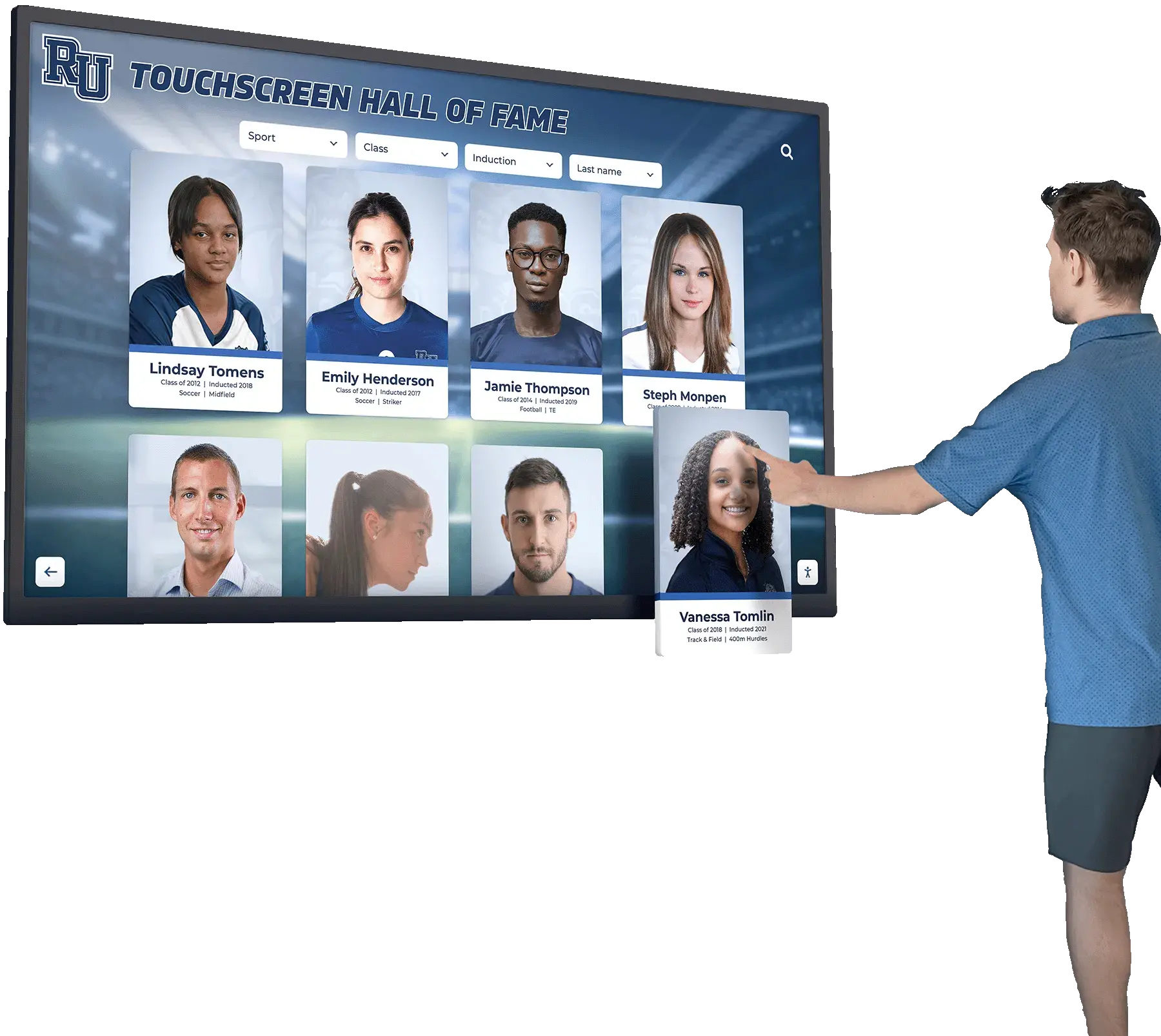
Digital Hall of Fame Definition and Core Concept
A digital hall of fame represents a modern recognition approach using interactive technology to celebrate achievement, preserve institutional history, and honor individuals or teams digitally rather than through traditional physical plaques, trophies, or printed displays.
Basic Components
At its simplest level, a digital hall of fame consists of three essential elements:
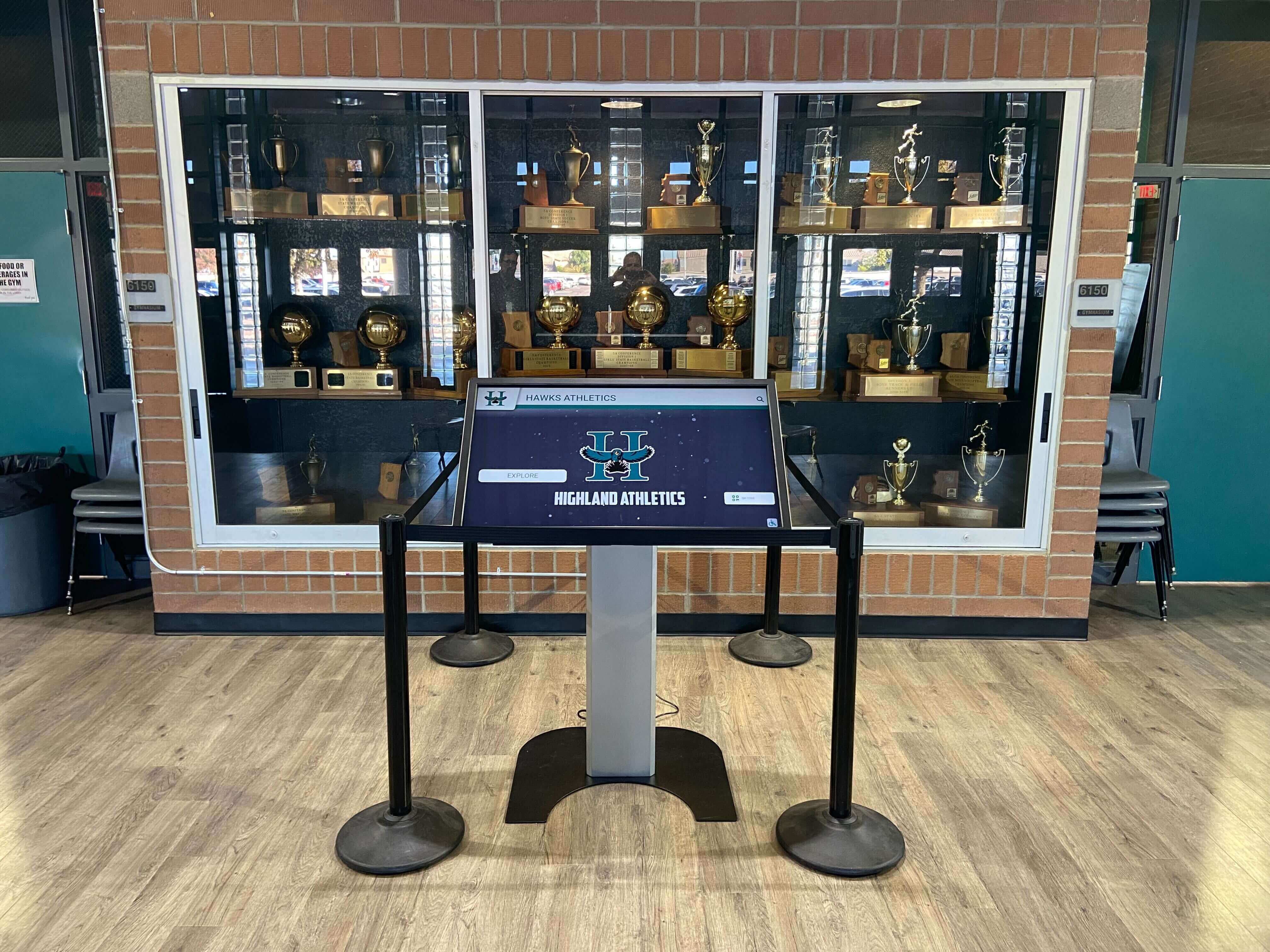
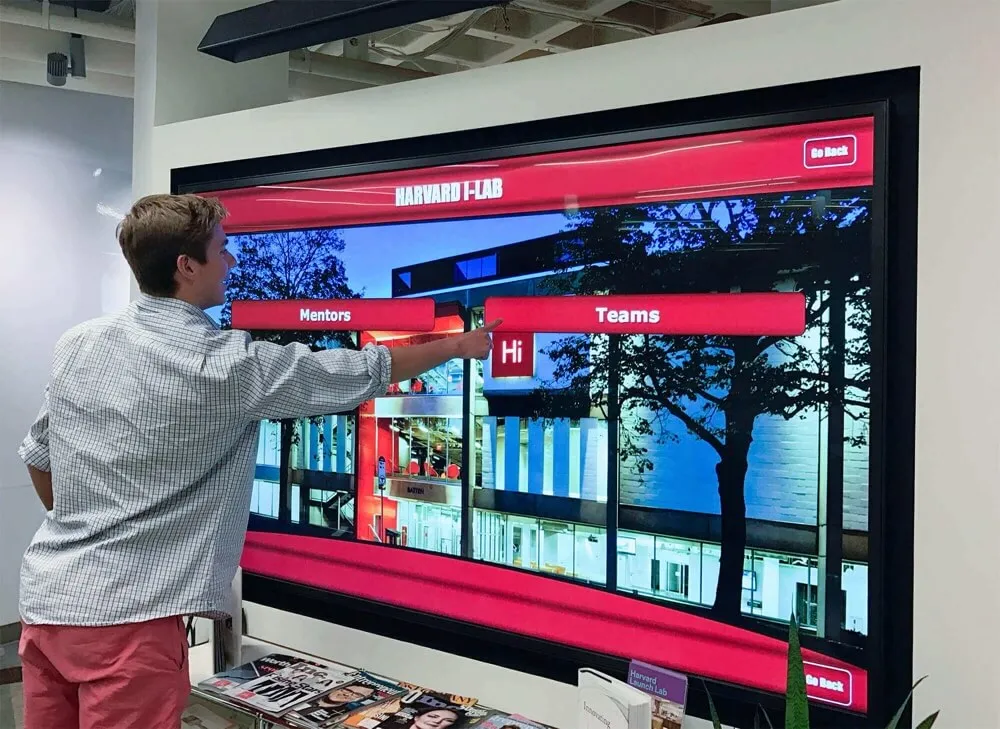
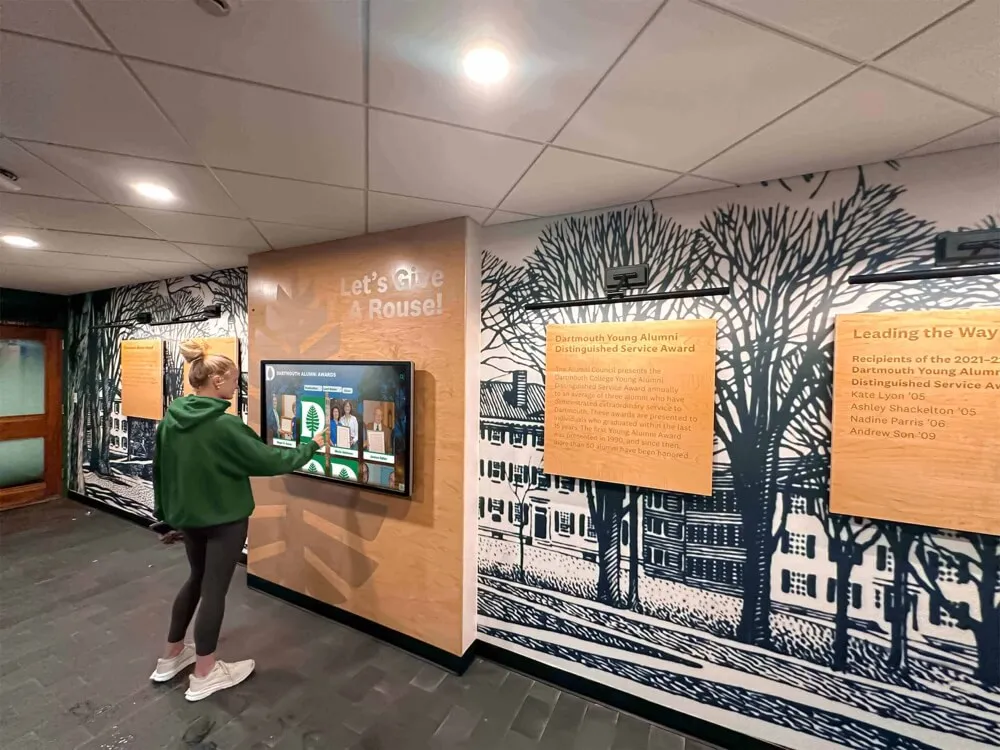
Display Hardware: Commercial-grade touchscreen monitors ranging from 43" to 86" diagonal, mounted on walls or integrated into free-standing kiosk enclosures. These displays function as interactive surfaces where visitors explore content through touch, similar to large tablets positioned vertically for public use.
Software Platform: Purpose-built recognition applications designed specifically for organizing, presenting, and managing profile-based content celebrating individuals, teams, and achievements. The software controls what appears on screen, how visitors navigate content, and how administrators add or update information.
Content Database: Structured collections of biographical profiles, photographs, videos, achievement records, historical information, and multimedia elements that comprise the actual recognition being celebrated. This content lives in cloud-based systems accessible from the touchscreen displays and companion web portals.
How Digital Halls of Fame Work
Visitors approach touchscreen displays and interact through touch gestures—tapping to select profiles, swiping to browse galleries, typing to search for specific names, and scrolling through detailed biographical information. The experience resembles using a smartphone or tablet but scaled for public viewing with interfaces optimized for quick comprehension by first-time users.
Behind the scenes, cloud-based content management systems store all profile information, images, and videos on remote servers. Touchscreen displays maintain persistent network connections, continuously pulling updated content from cloud platforms. When administrators add new inductees or update existing profiles remotely, changes appear automatically on all connected displays without requiring physical modifications.
This architecture enables organizations to manage recognition programs from any internet-connected device—administrators can upload new profiles from office computers, update biographical information from home laptops, or make corrections from mobile devices while traveling. The physical displays require no local management beyond basic cleaning and maintenance.
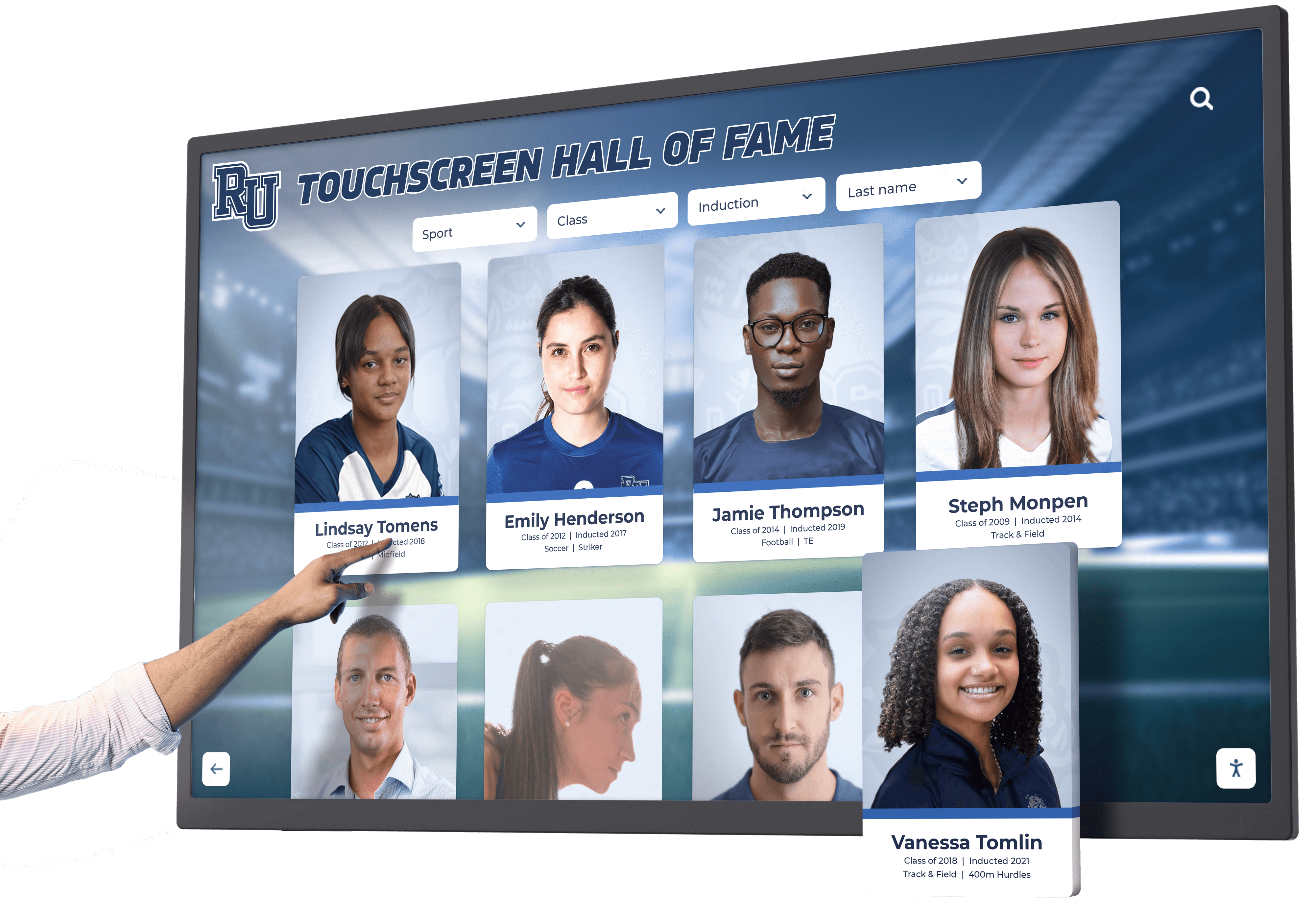
What Makes Digital Halls of Fame Different from Traditional Recognition
Understanding what distinguishes digital recognition from conventional approaches clarifies why organizations increasingly adopt these systems despite higher initial investment compared to basic plaques.
Unlimited Recognition Capacity
Traditional physical displays face absolute space constraints. A wall accommodates only finite numbers of plaques before exhausting available area. Trophy cases fill completely. Photo galleries reach maximum density. Once space runs out, organizations face difficult decisions: find additional wall space, remove older recognition to make room for new inductees, or stop adding new honorees entirely.
Digital halls of fame eliminate this fundamental limitation. A single 55" touchscreen can showcase 10, 100, 1,000, or 10,000 profiles with identical ease. The digital nature means adding new inductees requires no physical space whatsoever—just upload new content to the cloud platform and it appears instantly on displays. Organizations can recognize every deserving individual across decades without ever confronting space exhaustion.
This unlimited capacity proves particularly valuable for schools with long athletic traditions, universities with extensive alumni networks, or organizations celebrating achievement over many years. Recognition programs can grow indefinitely without requiring construction, wall space acquisition, or removal of earlier honorees.
Rich Multimedia Storytelling
Physical plaques typically accommodate names, dates, and brief achievement summaries—perhaps 50-100 words maximum. Traditional displays cannot incorporate video, cannot present large photograph collections, and cannot include interactive timelines or detailed narratives without overwhelming physical space with text nobody will read.
Digital profiles support comprehensive biographical narratives running 500-1,000 words, multiple high-resolution photographs showing life stages and memorable moments, embedded video interviews where inductees discuss careers and share advice, audio clips preserving oral histories and personal reflections, scanned documents like newspaper clippings or certificates, interactive achievement timelines showing progression across years, and statistics or records presented in organized tables or visualizations.
This multimedia depth transforms recognition from basic acknowledgment into rich storytelling that engages visitors emotionally while preserving institutional memory comprehensively. Current students can watch video interviews where alumni describe how education prepared them for success. Families can explore comprehensive photograph galleries documenting complete careers. Researchers can access historical documents preserved digitally.
The difference resembles comparing a business card to a comprehensive biography—both acknowledge a person, but one creates genuine understanding while the other provides minimal information.
Instant Updates Without Fabrication Costs
Traditional recognition requires physical fabrication for every addition or change. Adding a new inductee means ordering plaques (2-4 weeks), scheduling installation ($100-400 per plaque), and coordinating facilities access. Correcting errors requires removing plaques, ordering replacements, and reinstalling. Updating information as inductees achieve new milestones remains essentially impossible—you cannot edit brass.
Digital systems update instantly through administrative interfaces. Administrators log into cloud platforms, create new profiles, upload photos and biographical information, click publish, and new inductees appear immediately on all connected displays. Corrections take seconds—edit text, save changes, done. Enhancing profiles with new videos or updated achievements requires minutes rather than weeks.
This operational efficiency reduces administrative burden dramatically. Organizations report 75-80% time savings compared to traditional plaque coordination. More importantly, instant updates mean recognition remains current rather than perpetually outdated as inductees achieve new milestones that traditional displays cannot reflect.
Interactive Discovery and Engagement
Physical displays create passive viewing experiences. Visitors walk past, perhaps pause briefly to scan names, maybe read one or two plaques if something catches attention, then continue on. Engagement duration typically measures 15-45 seconds—barely enough to register recognition exists.
Digital halls of fame create active exploration. Visitors search for personal connections, browse by decade or achievement category, watch video interviews, explore photograph galleries, discover unexpected relationships between inductees, and spend meaningful time engaging deeply with content. Analytics from implementations consistently show average session durations of 5-8 minutes—ten times longer than traditional display engagement.
This extended engagement results from navigation enabling personalized exploration paths. Someone interested in athletic achievements filters to show only athletes. Alumni search for classmates from their graduation year. Community members browse chronologically to see how recognition evolved across decades. Each visitor creates their own journey through content based on personal interests.
The engagement difference mirrors comparing a museum exhibit where visitors actively control what they see versus a static poster where everyone receives identical limited information.
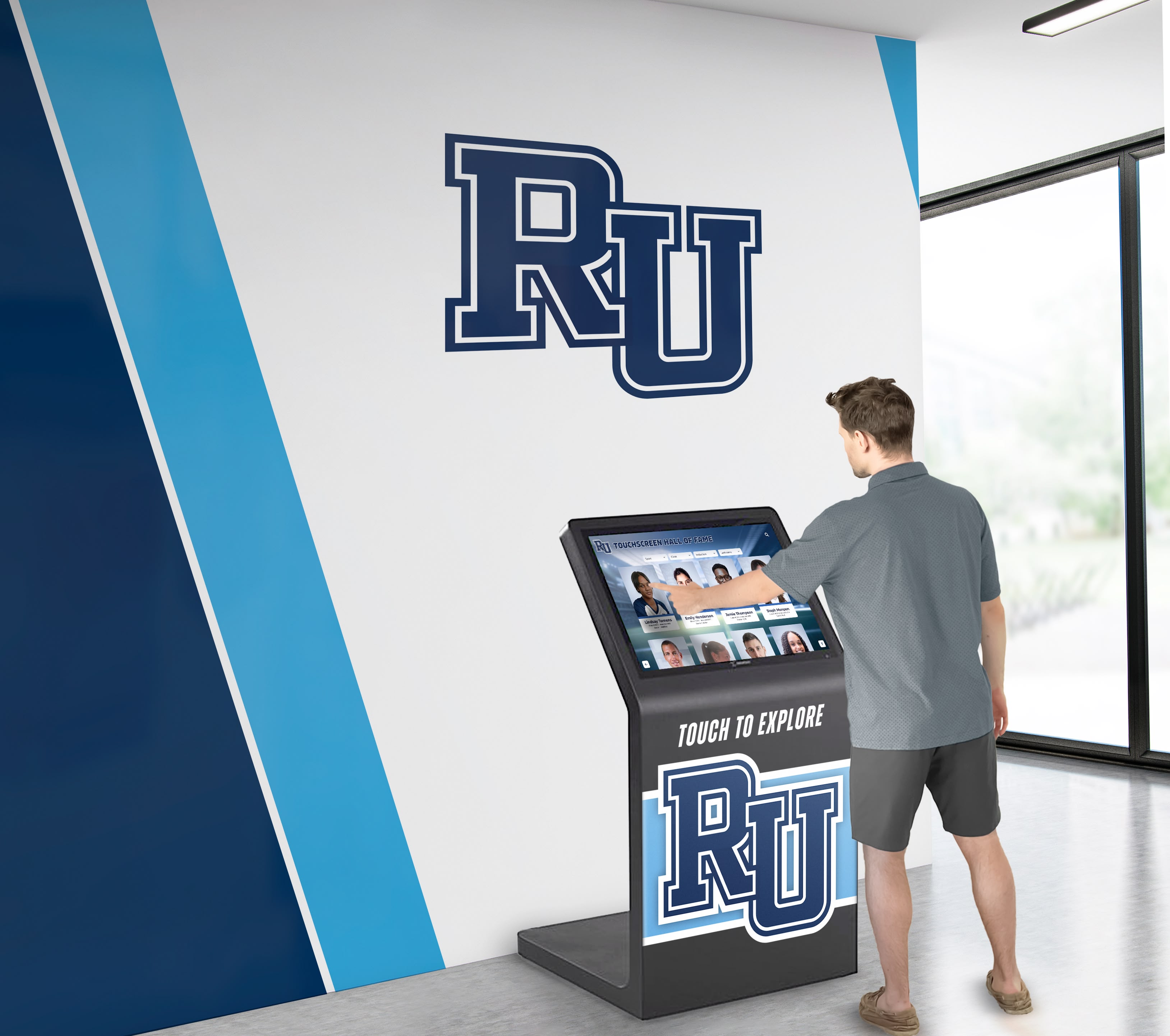
Who Uses Digital Halls of Fame
Recognition needs span diverse institutions and organizations, all finding digital solutions address unique challenges while enabling comprehensive celebration of achievement.
Educational Institutions
Schools and universities represent the largest user category for digital hall of fame technology, implementing systems to honor athletic excellence, academic achievement, distinguished alumni, dedicated teachers, and institutional history.
K-12 Schools use digital recognition to showcase state championship teams without overwhelming trophy cases, honor academic scholars and National Merit recipients, celebrate distinguished alumni who achieved notable success, recognize dedicated teachers serving long careers, and preserve school history through digitized yearbooks and historical photographs.
Secondary schools particularly benefit from unlimited capacity—high schools with 50-100 year histories can honor every championship team, every academic excellence recipient, and every distinguished graduate without confronting space limitations that force selective recognition.
Colleges and Universities implement digital halls of fame for athletic departments celebrating conference championships and professional athletes, advancement offices honoring major donors and distinguished alumni, academic departments recognizing faculty excellence and research achievement, student life divisions showcasing leadership and service awards, and institutional archives preserving comprehensive historical records.
Universities often deploy multiple displays across campus—athletic recognition in sports facilities, distinguished alumni in main administration buildings, donor recognition near advancement offices, and departmental achievements in academic buildings—all managed through unified content platforms.
Professional and Amateur Sports Organizations
Sports halls of fame at all competitive levels use digital displays to celebrate athletes, coaches, championship teams, and competitive excellence while preserving sports history and creating engaging fan experiences.
Professional sports organizations install digital recognition in stadium lobbies and concourses, creating interactive experiences where fans explore franchise history during events. Minor league teams, amateur sports clubs, recreational leagues, and youth sports organizations implement scaled versions celebrating achievement within budget constraints while providing professional-quality recognition.
Digital displays prove particularly valuable for sports recognition because they integrate video highlights, comprehensive statistics, championship moment recreations, and career timelines—content types that create powerful emotional connections impossible with static text and photographs alone. For organizations looking to showcase athletic excellence comprehensively, touchscreen digital hall of fame displays offer specialized features optimized for sports content.
Corporate and Nonprofit Organizations
Businesses and nonprofit organizations implement digital recognition to honor employee excellence, celebrate organizational milestones, recognize donor contributions, preserve company history, and strengthen organizational culture through visible acknowledgment of achievement.
Corporate installations often showcase employee of the year recipients, sales achievement leaders, recognition award winners, service milestone celebrations, and leadership development program graduates. Digital systems simplify ongoing management while ensuring recognition remains visible and current.
Nonprofit organizations particularly value digital recognition for donor walls acknowledging philanthropy without physical plaque limitations. A single touchscreen can honor thousands of contributors across all giving levels, updating instantly as new donations occur while providing rich storytelling about organizational impact that static donor walls cannot match.
Community and Religious Organizations
Municipalities, fraternal organizations, veterans groups, and religious institutions use digital recognition to honor community service, celebrate organizational history, recognize volunteer contributions, and preserve cultural heritage.
These organizations often operate on limited budgets but serve communities deserving comprehensive recognition. Digital solutions enable professional-quality recognition at scale previously accessible only to better-funded institutions. For community-focused recognition programs, exploring options for digital donor recognition displays provides relevant examples of effective community celebration.
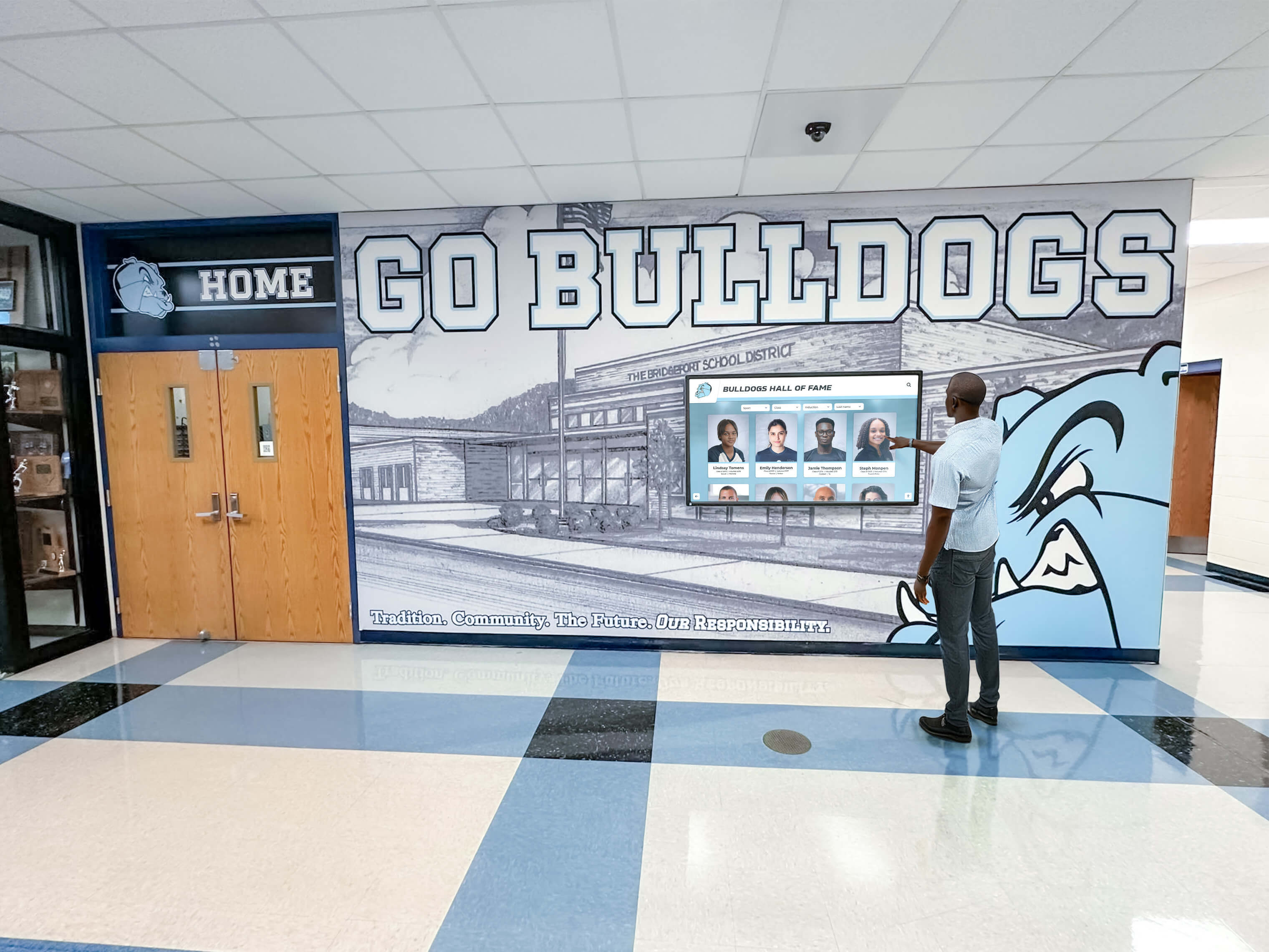
Technical Components of Digital Hall of Fame Systems
Understanding the technology elements helps organizations evaluate options, plan implementations, and set realistic expectations for capabilities and requirements.
Display Hardware Requirements
Commercial-Grade Touchscreens: Consumer-grade displays designed for 4-6 hours daily home use fail rapidly in institutional environments requiring 8-16 hours continuous operation. Commercial displays feature components rated for extended operation, enhanced cooling preventing overheating, reinforced enclosures protecting internal electronics, and warranties covering institutional use.
Screen sizes typically range from 43" for intimate spaces with close viewing distances to 86" for large lobbies with longer sight lines. Most installations use 55-65" displays balancing visibility, touch accuracy, and cost. Capacitive touch technology delivers the responsive, precise interaction users expect based on smartphone experience, though infrared touch alternatives work for very large displays where capacitive becomes prohibitively expensive.
Mounting and Enclosure Options: Wall-mounted displays integrate cleanly into architectural environments, consuming no floor space while blending with existing decor. Installations require solid backing structure supporting 80-150 pound combined weight of display and mounting hardware, plus electrical outlets and network connections positioned behind mounting locations.
Free-standing kiosk enclosures provide installation flexibility in spaces lacking suitable walls, enable repositioning when needs change, and create bold architectural statements drawing attention to recognition displays. Commercial kiosks feature steel construction, integrated cable management, lockable equipment access, and weighted bases ensuring stability without floor anchoring.
Software Platform Capabilities
Purpose-built recognition software distinguishes effective digital halls of fame from generic digital signage repurposed inappropriately. Recognition-specific platforms organize content around profile-based structures accommodating detailed biographies, achievement categories, relationship connections, and multimedia galleries.
Administrative Content Management: User-friendly interfaces enable non-technical staff to create profiles, upload multimedia content, organize categories, schedule features, and manage permissions without IT intervention. Intuitive design reduces training requirements—most platforms require 1-2 hours instruction for basic competency.
Essential features include drag-and-drop media upload, templated profile structures ensuring consistency, bulk import for historical data migration, approval workflows for quality assurance, scheduled publishing for timed releases, and role-based permissions controlling access.
Visitor-Facing Navigation: Touchscreen interfaces provide powerful search with auto-complete suggestions, alphabetical browsing, filtering by year or category, achievement-type organization, and related profile recommendations encouraging exploration.
Search quality critically impacts user experience—systems should return results within 1-2 seconds regardless of database size. Interfaces must remain intuitive for first-time users who lack instruction and won’t tolerate learning curves.
Web Portal Integration: Cloud-based platforms should provide companion websites enabling remote access from desktop and mobile devices. Web portals extend recognition reach to alumni anywhere, enable social sharing amplifying visibility, support family exploration outside campus visits, and demonstrate institutional commitment to digital accessibility.
Network and Power Infrastructure
Modern digital halls of fame require reliable network connectivity for cloud-based content management, remote updates, and analytics collection. Wired Ethernet connections deliver superior reliability compared to wireless networks, though WiFi installations work when achieving -67dBm or stronger signal strength.
Coordinate with IT departments ensuring network configurations permit required cloud services, appropriate VLAN assignments, and firewall rules allowing necessary traffic. Most platforms require outbound HTTPS for content delivery, software updates, and administrative access.
Displays consume 150-400 watts depending on size, requiring dedicated power outlets positioned behind mounting locations preventing visible cabling. Circuit capacity should support additional load without overloading typical 15-20 amp branch circuits. Commercial-grade surge protection prevents equipment damage from power fluctuations.
Content Development for Digital Hall of Fame Success
Technology provides enabling infrastructure, but content quality determines whether recognition displays genuinely engage visitors or become ignored installations. Organizations investing appropriately in content strategy and development achieve powerful recognition justifying technology expenditure.
Essential Profile Components
Comprehensive recognition profiles balance structured information with engaging storytelling, creating rich experiences that honor inductees appropriately while maintaining visitor interest.
Biographical Narratives: Effective biographies run 300-600 words, contextualizing achievements within life trajectories. Begin with early background including formative experiences and influences. Detail institutional years highlighting achievements, leadership, and relationships. Document post-graduation progression including career advancement, professional accomplishments, and ongoing institutional connections. Conclude with current status and lasting impact perspective.
Write in third person maintaining professional tone while incorporating personality through specific anecdotes and quotations. Avoid generic platitudes—instead provide specific examples demonstrating claimed characteristics through memorable stories and concrete details.
Photography Standards: Recognition profiles require professional-quality portraits at minimum 3000x4000 pixel resolution, proper lighting creating even illumination, clean backgrounds avoiding distraction, and tight composition focusing on faces rather than full-body shots losing detail at screen sizes.
Beyond primary portraits, include 4-8 supplemental images: action photographs showing competitive moments, team photos contextualizing group success, award ceremony captures, casual photographs revealing personality, and current images alongside historical photographs illustrating life progression.
Video Content Guidelines: Video interviews provide compelling personal dimension impossible through text. Effective videos run 2-5 minutes, balance production quality with conversational authenticity, feature well-lit subjects against clean backgrounds, and incorporate clear audio plus descriptive captions ensuring accessibility.
Structure interviews around reflective questions: favorite memories during institutional years, influential mentors, how experiences prepared for later success, advice for current students, and personal reflections on recognition meaning. Athletic recognition benefits particularly from highlight footage showcasing competitive excellence through 60-90 second reels featuring signature moments.
Content Quality Standards
Implement systematic quality assurance ensuring every profile meets consistency and accuracy standards before publication:
Verify factual accuracy through primary sources including yearbooks, newspaper archives, athletic records, and academic transcripts. Secure biographical approval from inductees when possible, confirming comfort with content. Ensure photography meets resolution requirements with reproduction rights secured. Test video playback confirming smooth performance without technical errors. Conduct thorough spelling and grammar review through multiple editorial passes. Confirm formatting consistency with established templates and style guides.
Organizations achieving recognition excellence establish documented style guides, profile development templates, peer review processes, and quarterly content refresh cycles maintaining quality as programs mature. For schools managing recognition content at scale, reviewing approaches from institutions implementing comprehensive digital recognition systems provides practical operational guidance.
Implementation Planning and Timeline
Successful digital hall of fame deployments require methodical planning addressing technical, organizational, and content dimensions before procurement begins.
Stakeholder Alignment Requirements
Assemble decision-making teams including facilities directors handling infrastructure and installation, IT directors managing network and security, advancement or athletic directors owning content and recognition criteria, communications directors ensuring brand standards, finance officers controlling budget and procurement, and institutional leaders providing decision authority.
Define each stakeholder role explicitly—who provides input, who holds veto authority, who makes final selections. Unclear decision processes stall projects when disagreements arise about vendors, locations, or features.
Space Assessment and Location Selection
Measure available space accounting for required clearances. Commercial touchscreens ranging 43-86" require 4-8 feet horizontal space and 3-6 feet vertical clearance. Document ceiling heights, architectural features, sight lines from traffic flows, and viewing distances. Position screens 8-15 feet from walkways for optimal visibility without congestion.
Survey lighting conditions throughout proposed locations at different times. Direct sunlight creates glare rendering screens unviewable—avoid unshaded windows or install light control. Evaluate ambient noise impacting audio playability. Measure temperature and humidity confirming climate-controlled environments maintaining 50-90°F temperatures and 20-80% humidity.
Verify network connectivity and power availability. Survey for existing network drops or WiFi coverage providing stable connections. Confirm electrical circuits support additional device load. Budget for infrastructure additions when existing facilities prove inadequate—$500-2,000 for network drops, $300-1,500 for electrical circuits.
Realistic Implementation Timeframes
Digital hall of fame implementations typically require 3-6 months from initial planning through launch. Budget 4-6 weeks for planning and stakeholder alignment, 2-3 weeks for vendor selection and procurement approval, 6-8 weeks for hardware delivery and software configuration, 2-4 weeks for installation and technical setup, and 2-3 weeks for content development and quality assurance.
Build 20-30% schedule contingency accommodating procurement bureaucracy, committee indecision, facility coordination conflicts, and content development underestimation. Coordinate launches with natural milestones—homecoming weekends, reunion events, academic year starts, or dedication ceremonies—rather than forcing artificial deadlines creating rushed implementation.
Cost Analysis and Budget Planning
Understanding financial requirements enables realistic decision-making and appropriate solution selection for organizational needs and constraints.
Initial Investment Components
Hardware Costs: Commercial-grade touchscreen displays cost $3,000-$12,000 depending on screen size, touch technology, and commercial quality. Entry-level 43" displays start around $3,000, popular 55" sizes range $4,000-$6,000, and large 75-86" displays reach $8,000-$12,000. Free-standing kiosks add $2,000-$6,000 versus wall-mounting but eliminate wall preparation expenses and provide installation flexibility.
Software Licensing: Purpose-built recognition platforms typically charge initial setup fees plus ongoing subscriptions. Expect $2,000-$8,000 initial configuration covering account setup, training, customization, and content migration assistance. Ongoing subscriptions cost $2,000-$6,000 annually per installation depending on features, support levels, and content capacity.
Installation and Infrastructure: Professional installation by commercial integrators costs $1,500-$4,000 per display covering mounting, cable management, electrical coordination, and finished appearance. Budget additional infrastructure when required—electrical circuits, network drops, wall reinforcement, or architectural integration.
Content Development: Initial content creation represents substantial investment, often exceeding technology costs. Budget for photography ($100-300 per subject), writing and editing ($50-150 per profile), video production ($500-2,000 per subject), historical research and digitization ($25-75 per profile), and project management ($5,000-15,000 for comprehensive programs).
Many organizations develop content using internal staff, trading budget expenditure for time allocation. Calculate equivalent costs based on hourly rates and realistic time estimates—comprehensive profiles typically require 4-8 hours depending on research complexity.
Long-Term Operational Expenses
Annual Software Subscriptions: Cloud-based platforms charge recurring fees covering software licensing, cloud hosting, automatic backups, ongoing updates, technical support, and administrative access. Annual costs typically range $2,000-6,000 per display with volume discounts for multiple installations.
Content Updates and Additions: Recognition programs require ongoing content investment adding new inductees, updating existing profiles, refreshing features, and enhancing historical profiles as materials surface. Budget 40-80 hours annually for established programs, translating to $2,000-6,000 for staff time or contracted services.
Hardware Maintenance: Commercial displays typically operate reliably 5-7 years before requiring replacement. Budget $500-1,000 annually in reserve for unexpected repairs—failed power supplies, damaged touchscreens, or component failures occurring occasionally despite quality equipment.
Return on Investment Considerations
While digital systems carry higher initial investment than basic plaques, total cost of ownership favors digital approaches within 3-5 years. Traditional plaques cost $100-400 per inductee for fabrication and installation. Institutions inducting 10 individuals annually spend $1,000-4,000 yearly, reaching $10,000-40,000 over 10 years before accounting for space exhaustion forcing expensive expansion.
Digital recognition achieves cost parity with traditional approaches within 3-5 years while providing unlimited capacity, eliminating per-inductee expenses, reducing administrative burden by 60-80%, and avoiding eventual space constraints necessitating expensive renovation.
Beyond direct cost comparison, institutions report increased alumni giving participation, higher event attendance, improved prospective student perception, and enhanced community engagement—qualitative benefits that justify recognition investment through advancement and enrollment impact.
Operational Management and Maintenance
Recognition programs require ongoing operational commitment ensuring displays remain functional, content stays current, and systems adapt as institutional needs evolve.
Routine Maintenance Requirements
Daily Operations: Modern cloud-based systems handle most operations automatically. Displays wake at scheduled times (typically 6 AM), connect to cloud platforms retrieving content updates, display recognition throughout operational hours, and enter sleep mode at scheduled times (typically 10 PM) reducing power consumption.
Monitor operations through cloud dashboards showing online/offline status. Investigate devices appearing offline consistently, indicating network issues, power problems, or hardware failures requiring attention.
Weekly Physical Maintenance: Clean touchscreen glass using microfiber cloths and appropriate screen cleaning solutions (avoid ammonia-based cleaners damaging coatings). Wipe bezels, enclosures, and surrounding areas removing dust. Verify displays operate properly—check image quality, touch responsiveness, and audio when applicable.
Monthly Content Reviews: Review recently published content verifying accuracy and quality standards. Check featured rotations ensuring diversity. Scan analytics identifying popular content and improvement opportunities. Verify media playback, test external links confirming active destinations, and validate search functionality.
Quarterly System Assessments: Conduct comprehensive examinations of hardware health, software currency, content freshness, security compliance, and usage patterns. Review analytics identifying trends. Test interface usability observing actual visitors when possible. Coordinate vendor software updates and security patches.
Content Management Best Practices
Establish systematic workflows ensuring consistent quality across all recognition profiles while distributing workload manageably. Assign staff roles explicitly—researchers gathering information, writers drafting narratives, photographers creating visual content, editors reviewing quality, approvers authorizing publication, and publishers uploading completed profiles.
Create profile development templates standardizing information categories and formatting. Develop style guides addressing tone, terminology, and standards. Implement peer review where creators review others’ work catching errors individuals overlook. Schedule quarterly content refresh cycles updating outdated information and enhancing profiles as new materials surface.
Document procedures, maintain content calendars scheduling profile additions, and cross-train multiple staff preventing program disruption when personnel changes occur. Organizations relying on single-person knowledge create substantial risk when inevitable transitions happen.
Advantages of Digital Halls of Fame
Understanding specific benefits helps organizations evaluate whether digital recognition matches institutional needs and priorities better than traditional alternatives.
Scalability Without Space Constraints
A single touchscreen accommodates 10 or 10,000 profiles with identical ease. Organizations can recognize every deserving individual across decades without confronting space limitations forcing selective recognition. This unlimited capacity particularly benefits schools with long traditions, universities with extensive alumni networks, or organizations celebrating achievement over many years.
Recognition programs can grow indefinitely without requiring construction, wall space acquisition, or removal of earlier honorees. For schools managing long-term athletic recognition, understanding approaches to basketball halls of fame provides relevant examples of comprehensive sports celebration.
Enhanced Visitor Engagement
Interactive exploration, powerful search capabilities, filtering options, and multimedia content increase visitor engagement time from seconds to minutes. Analytics consistently show average session durations of 5-8 minutes with digital displays versus 15-45 seconds for traditional static recognition.
Extended engagement results from personalized exploration paths. Athletic fans filter to show only sports achievements. Alumni search for classmates. Community members browse chronologically. Each visitor creates their own journey based on personal interests rather than consuming identical limited content.
Remote Content Management
Update profiles instantly through cloud-based administrative interfaces accessible from any internet-connected device. Add new inductees, correct errors, enhance profiles, and publish changes in minutes without physical modifications, contractor scheduling, or fabrication delays.
This operational efficiency reduces administrative burden by 75-80% compared to traditional plaque coordination. Recognition remains perpetually current as inductees achieve new milestones that static displays cannot reflect.
Web Accessibility and Social Sharing
Cloud-based platforms provide companion websites enabling remote access from desktop and mobile devices worldwide. Alumni anywhere can explore comprehensive recognition, share profiles via social media, and maintain connection regardless of geographic distance.
Web portals amplify recognition reach dramatically—physical displays serve campus visitors while web access serves global alumni communities. Social sharing extends visibility exponentially as families and friends discover and share profiles online.
Inclusive Accessibility Features
Digital platforms incorporate accessibility accommodations traditional displays cannot match: screen reader compatibility for vision-impaired visitors, keyboard navigation alternatives to touch interfaces, adjustable text sizes accommodating varied vision capabilities, high-contrast modes improving readability, closed captions for video content, alternative text descriptions for images, and multilingual support serving diverse communities.
Organizations receiving federal funding or operating in accessibility-sensitive jurisdictions particularly value platforms meeting WCAG 2.1 AA compliance standards ensuring equal access for all community members.
Common Questions About Digital Halls of Fame
Organizations evaluating recognition options frequently ask similar questions during research and planning phases.
How difficult is content management?
Modern recognition platforms feature user-friendly interfaces requiring minimal training. Most administrators achieve basic competency within 1-2 hours of instruction. Creating new profiles typically requires 15-30 minutes once biographical information and media are gathered—the administrative work involves data entry and upload rather than technical configuration.
Platforms designed specifically for recognition (versus generic digital signage adapted inappropriately) provide templated profile structures, drag-and-drop media upload, and intuitive publishing workflows that non-technical staff manage comfortably without IT intervention for routine operations.
What happens if technology fails?
Commercial-grade hardware with appropriate warranties typically operates reliably for 5-7 years. When technical issues occur, cloud-based systems enable remote diagnostics helping vendors or IT staff troubleshoot quickly. Most platforms include technical support with defined response times for urgent issues.
Organizations concerned about display downtime can deploy multiple installations providing redundancy—if one display requires service, others continue operating. However, hardware failure rates prove lower than organizations typically expect when specifying commercial-grade equipment versus consumer alternatives.
Can digital recognition replace all physical displays?
Many organizations implement hybrid approaches—select physical recognition in prominent locations paired with comprehensive digital systems providing unlimited capacity. This strategy maintains tangible presence while gaining digital advantages for scalability, engagement, and accessibility.
Complete replacement of traditional displays works well for schools with space constraints, organizations valuing operational efficiency over physical permanence, or programs prioritizing comprehensive recognition over selective physical celebration. However, hybrid approaches balance benefits of both technologies effectively.
How long does implementation take?
Typical implementations require 3-6 months from initial planning through launch. Hardware procurement takes longest (6-10 weeks for ordering and delivery), while installation and configuration complete relatively quickly (2-4 weeks). Content development duration varies based on profile numbers and complexity—organizations creating 50 initial profiles require more time than those starting with 10-15.
Rushing implementation creates quality compromises during content development or installation. Build realistic schedules accommodating planning, procurement, facilities coordination, and thorough content preparation ensuring successful launches that validate investment.
What if we have limited budget?
Recognition programs scale to budget constraints. Smaller displays cost less than large formats while serving intimate spaces effectively. Single installations cost less than multiple displays while providing complete recognition capacity. Starting with smaller initial inductee cohorts reduces content development costs while enabling program launch, then expanding recognition annually as budget permits.
Many organizations secure funding through alumni campaigns, donor sponsorships, booster club support, or grant applications rather than institutional operating budgets. Digital recognition often generates strong support from graduates eager to honor legacy and see their achievements included. For organizations exploring funding strategies, examining approaches to donor recognition displays provides relevant fundraising examples.
Digital Hall of Fame Best Practices
Organizations achieving exceptional recognition outcomes share common approaches reflecting systematic planning, quality execution, and ongoing operational commitment.
Start with Clear Vision
Define recognition purpose explicitly before selecting technology. Are you celebrating athletic excellence, honoring distinguished alumni, recognizing academic achievement, preserving institutional history, or supporting fundraising through donor recognition? Clear purpose drives appropriate feature selection, content priorities, and success metrics.
Establish objective selection criteria ensuring fairness and maintaining program credibility. Document nomination processes, selection committee structure, and approval workflows creating transparency that stakeholders trust.
Invest in Quality Content
Technology provides infrastructure, but content creates engagement. Allocate adequate time and resources for biographical research, professional photography, video production, and thorough editing. Rushed content development produces disappointing results that technology sophistication cannot overcome.
Organizations achieving recognition excellence treat content development as critical investment deserving professional attention rather than administrative burden to minimize. Comprehensive profiles honoring inductees appropriately while engaging visitors require substantive effort that shortcuts undermine.
Plan for Long-Term Operations
Recognition programs succeed through sustainable operational processes rather than heroic one-time efforts followed by neglect. Allocate dedicated staff time for ongoing content maintenance, establish documented procedures and style guides, cross-train multiple staff preventing single-person dependency, and schedule regular content review cycles maintaining quality as programs mature.
Organizations treating digital halls of fame as “set and forget” technology consistently experience degraded performance, outdated content, and eventual abandonment wasting initial investments. Successful programs build operational sustainability from the beginning.
Select Recognition-Specific Platforms
Purpose-built recognition software designed specifically for celebrating individuals delivers dramatically better results than generic digital signage adapted inappropriately. Recognition platforms organize content around profile structures, prioritize search and discovery navigation, support multimedia depth, and provide administrative tools reflecting recognition program operational patterns.
Generic signage platforms excel at scheduled content rotation and passive message display but lack profile organization, powerful search, and interactive discovery that recognition demands. The 20-40% cost savings versus specialized platforms vanishes through operational inefficiency and compromised functionality.
Why Schools and Organizations Choose Rocket Alumni Solutions
Institutions conducting thorough evaluations consistently select Rocket Alumni Solutions for digital hall of fame implementations because the platform excels across every critical dimension:
Recognition-Specific Design: Software architecture built specifically for showcasing individuals, teams, and achievements rather than adapted from corporate digital signage. Every feature reflects deep understanding of recognition program needs.
Exceptional Usability: Administrative interfaces require minimal training enabling non-technical staff to manage comprehensive programs confidently without constant IT involvement. Intuitive design reduces operational burden while ensuring sustainable management.
Unlimited Scalability: Cloud architecture accommodates thousands of detailed profiles without performance degradation, supporting institutional growth across decades without platform limitations or expensive migrations.
Comprehensive Features: Rocket includes everything institutions need—sophisticated search and navigation, rich multimedia support, web portal integration, mobile optimization, accessibility compliance, analytics and insights, and multi-display management—without complex configuration or custom development.
Proven Track Record: Over 1,000 installations across all 50 states demonstrate Rocket’s reliability, versatility, and sustained customer satisfaction. Organizations trust Rocket because the platform consistently delivers across diverse institutional contexts.
Dedicated Partnership: Rocket provides comprehensive implementation support, ongoing technical assistance, content strategy consultation, and continuous platform improvements ensuring long-term success. Organizations value partnership approach versus transactional vendor relationships ending after initial sale.
Ready to explore how digital hall of fame technology can transform your recognition program? Talk to our team to see how Rocket Alumni Solutions delivers comprehensive, intuitive recognition systems built specifically for your needs.
Conclusion: Understanding Digital Hall of Fame Value
A digital hall of fame represents far more than technology adoption—it fundamentally transforms how organizations celebrate achievement, preserve legacy, and inspire future excellence. These systems eliminate space constraints that eventually overwhelm traditional recognition, reduce administrative burden by 75% or more, create engaging experiences impossible with static displays, and provide unlimited capacity growing effortlessly across decades.
Successful implementations require systematic approaches addressing technical infrastructure, content quality, user experience design, and operational sustainability. Organizations rushing through planning, underinvesting in content development, or treating installations as “set and forget” technology consistently experience disappointing outcomes. Those following comprehensive frameworks achieve recognition that validates investment while delivering measurable advancement and engagement impact.
Understanding what digital halls of fame are, how they work, what they require, and why organizations adopt them enables informed decision-making about whether these systems match institutional needs better than traditional alternatives. For schools with space constraints, organizations committed to comprehensive recognition, or programs valuing operational efficiency and engaging experiences, digital recognition offers compelling advantages justifying initial investment through long-term value.
Your achievements deserve recognition infrastructure matching their significance. With proper planning, appropriate technology selection, quality content development, and sustained operational commitment, digital hall of fame systems create recognition experiences that don’t just acknowledge accomplishment but genuinely inspire, engage, and strengthen community across generations.































